
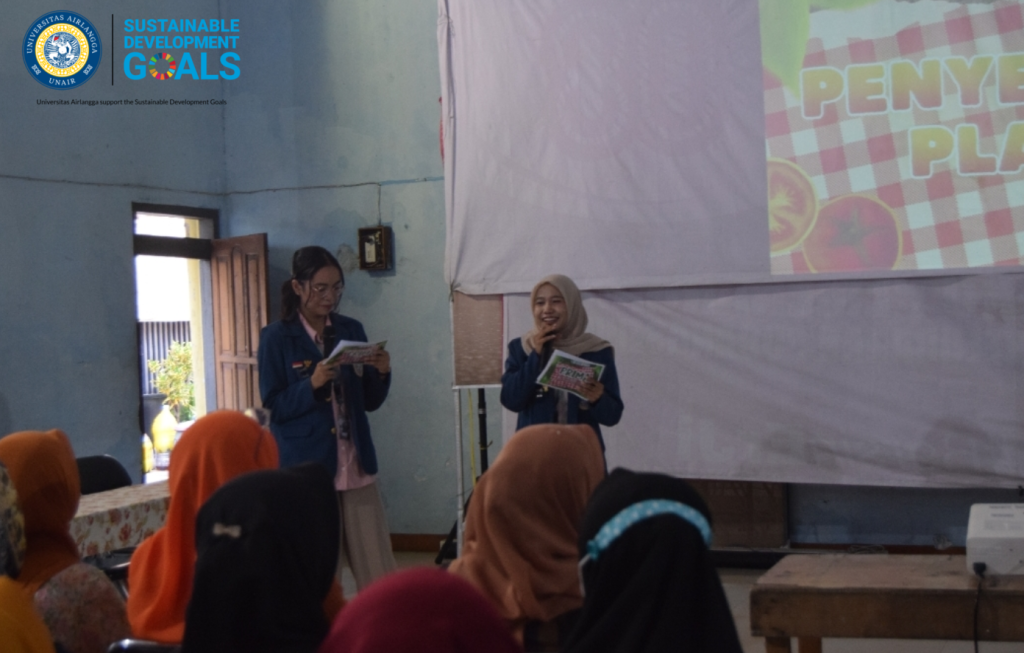
NERS NEWS — Surabaya – As a tangible manifestation of the implementation of Project Based Learning (PjBL), Group 1 Class A3/2024 students from Universitas Airlangga organized a community service activity entitled “PRIMA.” This activity was held on Wednesday, June 10, 2026, at the RW V Mojo Community Hall, Jl. Mojo V No. 22, Gubeng, Surabaya. Carrying the theme “Gastritis Prevention and Education for the Community,” this activity was designed to increase residents’ awareness and understanding of digestive health, particularly gastritis, commonly known as gastric ulcer disease. This activity was carried out in a structured and sustainable manner in the form of educating the residents of RW V Mojo about gastritis and its prevention. This activity was directly supervised and supported by a team of academic supervisors consisting of Nur Arifah Astri, S.Kep., Ns., M.Kep., Dr. Candra Panji Asmoro, S.Kep., Ns., M.Kep., and Prof. Ferry Efendi, S.Kep., Ns., M.Sc., PhD.
The “PRIMA” series of activities began with the participant registration process and a warm welcome through the singing of the Indonesian national anthem, “Indonesia Raya,” followed by welcoming remarks from the chief organizer, the academic supervisors, and the Head of RW V Mojo as a formal opening. The educational process was conducted interactively, in which residents first completed a pre-test to measure their initial understanding of gastric ulcer disease before the core material was presented. After the presentation of materials regarding triggering factors, symptoms, and preventive measures for gastritis, the committee opened an interactive question-and-answer session that was enthusiastically welcomed by the residents, followed by input from Mrs. Nur Arifah Astri, S.Kep., Ns., M.Kep., as one of the supervising lecturers of Group 1 Class A3/2024, before finally concluding with the completion of a post-test and an awarding session as appreciation for active participants.
This community service activity was organized by Universitas Airlangga students who were members of Group 1 Class A3/2024. The event was held on Wednesday, June 10, 2026, starting at 09:00 a.m. WIB, at the RW V Mojo Community Hall, Jl. Mojo V No. 22, RT 004/RW 005, Mojo, Gubeng District, Surabaya City, East Java. The educational program was attended enthusiastically by approximately 30 local residents who participated as active participants, accompanied directly by the supervising lecturers of Group 1 Class A3/2024 and fully supported by the administrators of RW V Mojo.
This activity was motivated by the persistently high incidence of gastritis at the family level due to irregular eating patterns and limited literacy regarding digestive health. Therefore, this activity aimed to share prevention tips that are easy for residents to practice in their daily lives, enabling them to detect symptoms early and adopt healthier lifestyle habits. Through this approach, the “PRIMA” activity directly supports the achievement of the Sustainable Development Goals (SDGs), particularly Goal 3 on Good Health and Well-Being by reducing morbidity rates in the community, and Goal 4 on Quality Education through the provision of inclusive and transformative health learning access for the general public.In its implementation, this
In its implementation, this activity integrated the principles of Sustainable Development Goals (SDGs), specifically Goal 3 concerning Good Health and Well-Being and Goal 4 concerning Quality Education. Through the Project Based Learning (PjBL) approach, students not only taught residents of RW V Mojo how to prevent disease in order to become healthier, but also invited them to learn together in an enjoyable and beneficial way. The integration of these two goals demonstrates that the dissemination of structured, educational, and easily understood health information can serve as a learning medium that empowers communities to live healthier lives independently and sustainably.
Overall, the implementation of the “PRIMA” activity through the Project Based Learning (PjBL) approach has had a positive impact in improving health literacy and encouraging the independence of RW V Mojo residents in preventing gastritis. In the future, this activity is expected to continue as tangible evidence of the university’s concern for the community. Through this collaboration, the university not only produces healthcare professionals who care for others but also contributes to achieving the SDGs targets in order to realize a healthier, more educated, and more prosperous Indonesian society.
Writer: Syahra Asih Nurhasanah
Editor: Nandyta Putri Rahmadhani (Airlangga Nursing Journalist)





