
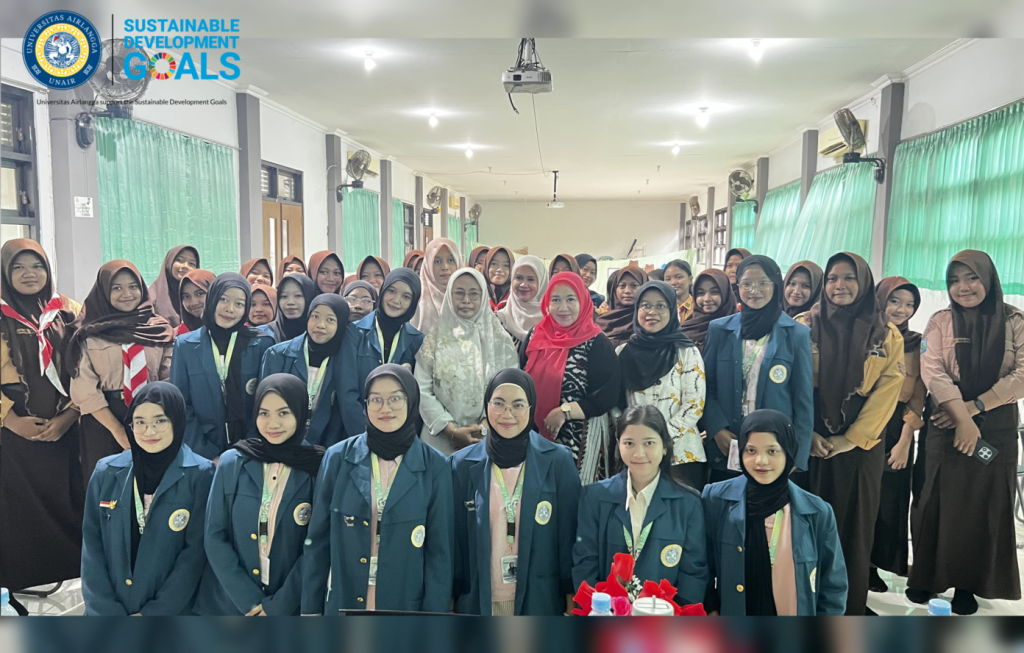
NERS NEWS — The rainy morning in Surabaya did not dampen the enthusiasm of Bachelor of Nursing students from Universitas Airlangga, Group 1 Class A4, in carrying out the Project-Based Learning (PjBL) activity entitled “PRISMA: Education and Literacy on Menstruation and Adolescent Psychosocial Health.” The activity, which took place at SMP Negeri 15 Surabaya, served as one of the efforts to provide health education to adolescents in order to improve their understanding of menstruation, reproductive health, and the importance of maintaining reproductive hygiene from an early age.
The activity was attended by 35 eighth-grade female students from SMP Negeri 15 Surabaya. The event began at 7:30 AM (WIB) with preparations by the organizing committee to ensure that each session would run smoothly. Participant registration started at 8:30 AM. The program officially opened at 9:00 AM, led by the Master of Ceremony (MC), followed by the singing of Indonesia Raya. The atmosphere grew warmer with opening remarks from the Chairperson of the Organizing Committee, Naura Azalia Hidayah; the school representative, Vice Principal for Curriculum of SMP Negeri 15 Surabaya, Mrs. Setyo Rini Dwi Astuti, S.Pd., M.Pd.; and the academic supervisor, Prof. Dr. Esti Yunitasari, who expressed support for the implementation of this activity. The event was also attended by the accompanying lecturer, Mrs. Praba Diyan Rachmawati, who provided guidance and support to the students throughout the activity.
Before entering the educational session, participants first completed a pre-test to assess their initial understanding of menstruation and reproductive health. Subsequently, the students delivered the educational materials interactively using PowerPoint presentations, educational videos, and a female reproductive organ phantom as a learning aid. The use of these media made the learning process more engaging, as participants were not only listening to explanations but were also able to directly observe illustrations of the female reproductive organs.
The materials covered an introduction to the anatomy and physiology of the female reproductive system, the menstrual process and cycle, various changes that occur during menstruation, myths and facts commonly found in society, and ways to maintain reproductive health. The educational session was delivered using the Socratic method through discussions and question-and-answer sessions, allowing students to actively express their opinions and ask questions about topics they had not yet fully understood.
Participants’ enthusiasm was evident during the discussion session. Several students actively asked questions regarding various experiences and information they had often heard related to menstruation. After the educational session, the activity continued with educational games containing questions about the materials that had been presented earlier. In addition to serving as an evaluation tool, these activities also made the learning atmosphere more enjoyable. One participant shared her impression of the activity. “The games were very challenging and informative because the questions were related to the material that had already been explained by the presenters. It helped us remember the material in a much more fun way,” she said.
As a final evaluation, participants completed a post-test to assess the improvement in their understanding after participating in the educational activity. The results of this evaluation became one of the indicators of the success of the PRISMA program in improving adolescents’ reproductive health literacy. The activity was then concluded with the presentation of awards to active participants and winners of the educational games as a form of appreciation for their participation and enthusiasm throughout the event, followed by a group documentation session.
Through the PRISMA PjBL activity, the Bachelor of Nursing students of Universitas Airlangga hope that education regarding menstruation and reproductive health can help adolescents obtain accurate information, reduce the spread of myths within their surroundings, and build awareness of the importance of maintaining reproductive health physically, psychologically, and socially.





