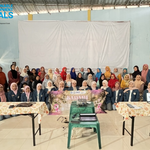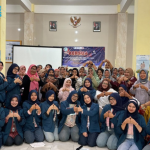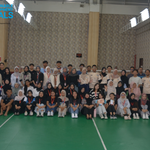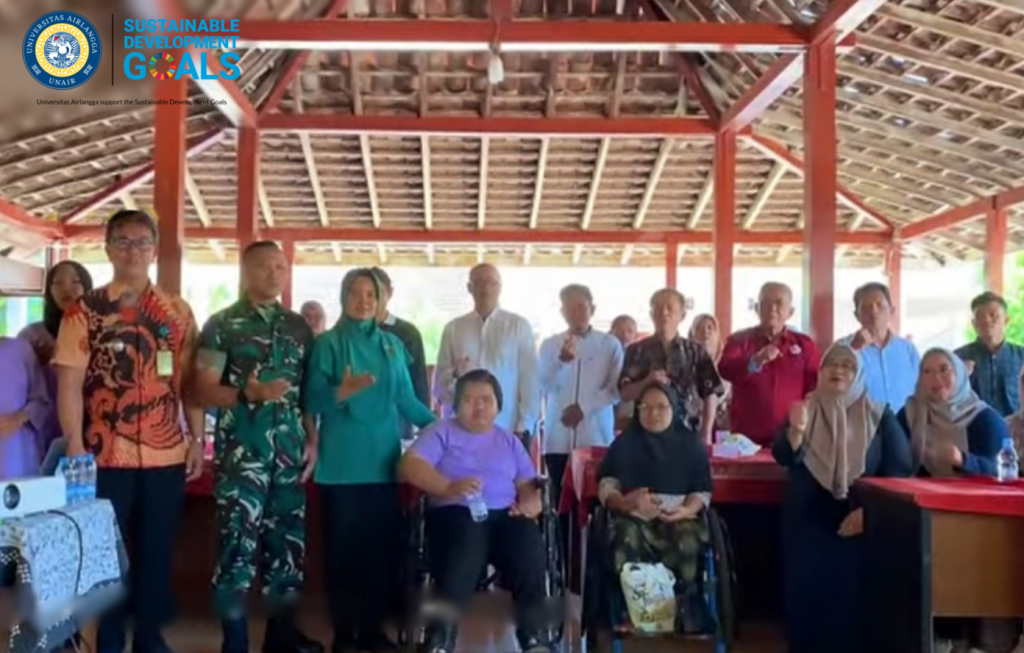
NERS NEWS — Economic empowerment for vulnerable community groups is being realized in Nanggulan. Through an herbal cosmetic product innovation, a training session on producing “Sabun Jaga” using avocado as the main ingredient was held at the Nanggulan Sub-district Hall on Friday, July 10, 2026. The participants consisted of women’s groups and persons with disabilities.
This training was a collaboration between PT Jasa Marga, Universitas Airlangga (Unair), and Agro Nanggulan. It reaffirmed the commitment to making a tangible contribution to society through the “Unair Berdampak” program. Professor at the Faculty of Nursing, Universitas Airlangga, Prof. Dr. Esti Yunitasari, S.Kp., M.Kes., played a leading role in this innovation alongside Dr. Yuni Priyandani, S.Si., Sp.FRS., Apt., Dr. Neny Purwitasari, S.Farm., M.Sc., Apt., as well as nursing and pharmacy students.
Professor at the Faculty of Nursing, Universitas Airlangga, Prof. Dr. Esti Yunitasari, stated that, as a higher education institution, Universitas Airlangga bears a significant responsibility to create positive changes that can be directly experienced by society. This commitment aligns with Universitas Airlangga’s achievement of being ranked first nationally in the implementation of the Sustainable Development Goals (SDGs).
“We must prove that universities should be present and make a direct impact on society. Through this training, we are giving special attention to our very special friends (persons with disabilities) as well as women so that they can become more empowered,” she said. Prof. Esti emphasized the importance of appreciating persons with disabilities not out of sympathy, but by providing opportunities and recognition for their independent work. Through this training, Universitas Airlangga directly contributes to six SDGs, including No Poverty (SDG 1), Decent Work and Economic Growth (SDG 8), Industry, Innovation and Infrastructure (SDG 9), and Gender Equality (SDG 5). Furthermore, Prof. Esti explained that avocado was selected as the primary raw material because of its abundance in the region. Universitas Airlangga identified a significant opportunity to optimize avocados that could not be absorbed by the market, allowing them to retain high economic value.
Based on laboratory studies and testing conducted by the Faculty of Pharmacy, Universitas Airlangga, avocados are not only rich in nutrients for consumption but also contain beneficial compounds for skin health when processed into cosmetic products. “Laboratory testing of the composition and properties of avocados has been scientifically conducted by our colleagues at the Faculty of Pharmacy, Universitas Airlangga, making them safe and beneficial for further development by the community,” she added.
Furthermore, Prof. Esti hopes that this initiative will become a new economic driver for the people of Nanggulan while serving as a sustainable model of inclusive collaboration among academics, local government, and the community. “If from 2017 to 2025 our focus was on empowering farmers, now is the time to shift toward empowering women and persons with disabilities who are vulnerable in terms of economic independence. Through this program, we are committed to unlocking their potential for long-term sustainability,” she explained.
Purdiyanta also expressed his appreciation to PT Jasa Marga for its full commitment to supporting the initial funding of the program. He explained that experts from the Faculty of Nursing and the Faculty of Pharmacy, Universitas Airlangga, were involved to ensure product standardization, safety, and quality. Drawing on the expertise of academics in cosmetic pharmacy, local avocados were successfully formulated into high-quality herbal bar soap. “We saw that avocado derivatives are highly suitable for cosmetic products. We chose soap because it is an everyday necessity. Since soap has a long shelf life and a high consumption rate, we are optimistic that these products will be well accepted by the market,” he said.
Purdiyanta further explained that a comprehensive marketing strategy has been prepared. Marketing efforts will not only rely on digital platforms with intensive assistance but will also involve local business networks. “Products made by persons with disabilities carry strong social value, and internationally, inclusive products receive significant attention and appreciation,” he stated. With an adaptive production target, Purdiyanta is confident that “Sabun Jaga” will soon be marketed on a larger scale following the training. In the future, the program is expected to inspire other state-owned enterprises to establish similar initiatives so that persons with disabilities throughout Kulon Progo Regency can be included in an independent and inclusive economic ecosystem.
The Commander of Military District Command 0731/Kulon Progo, Lieutenant Colonel Inf. Dyan Niti Sukma, stated that Kulon Progo possesses tremendous natural potential that has yet to be fully explored. He added that Nanggulan is particularly suitable for horticultural commodities and has become one of the leading agrotourism areas, especially for longan and avocado production. “This is an opportunity to showcase our potential, particularly in the agrotourism sector. Nanggulan is extraordinary, its land is ideal for cultivating avocados, longans, and durians. Thankfully, Nanggulan is already generating considerable income from longan and avocado production,” he said.
Furthermore, Dyan expressed his hope that, through this training, local commodities would no longer be sold merely as raw materials but could instead be developed into high-value Micro, Small, and Medium Enterprise (MSME) products. Through collaboration with academics, Dyan encouraged all stakeholders to remain committed to ensuring the sustainability of these MSME products so they can continue to grow in the broader market.
Writer: Annita Istifadhah