
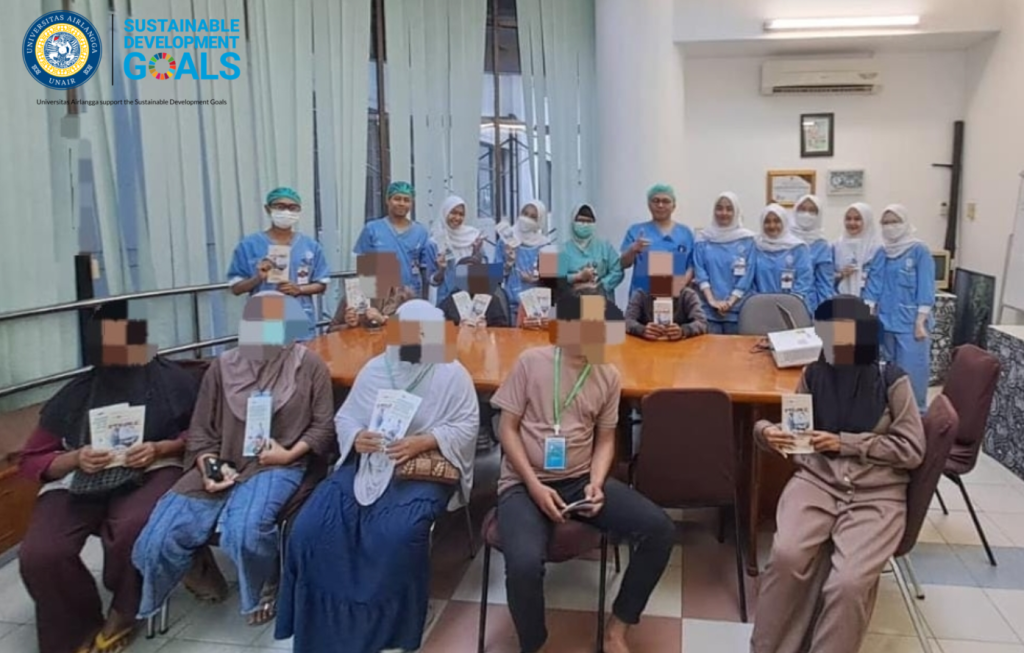
NERS NEWS — Nursing Profession students from the Faculty of Nursing, Universitas Airlangga who are undergoing professional practice at the GBPT ICU of RSUD Dr. Soetomo Surabaya conducted a Hospital Health Promotion (PKRS) activity with the theme “Stroke: Recognize, Prevent, and Treat Early.” The activity was held in the Meeting Room on the 2nd Floor of the GBPT Building, RSUD Dr. Soetomo Surabaya, and was attended by family members accompanying their relatives during treatment in the GBPT ICU.
The PKRS activity was also attended by Academic Supervisor Erna Dwi Wahyuni, S.Kep., Ns., M.Kep., Clinical Supervisor Guguk Sedyofiatno, S.Kep., Ns., and the Head of the GBPT ICU, who supported the implementation of health education as part of efforts to improve service quality and patient safety. The education aimed to increase patients’ families’ knowledge and understanding of stroke, particularly its definition, types, risk factors, signs and symptoms, prevention efforts, first aid, and the important role of families in supporting the care and recovery of stroke patients.
Stroke is a condition in which blood flow to the brain is disrupted due to a blockage or rupture of a blood vessel, causing brain tissue to receive insufficient oxygen and nutrients. This condition can result in impaired bodily functions, such as weakness in the limbs, speech difficulties, visual disturbances, and decreased consciousness. Therefore, stroke is a medical emergency that requires immediate treatment.
During the health education session, the presenters discussed the definition of stroke, the classification of ischemic and hemorrhagic stroke, risk factors, stroke signs and symptoms using the SeGeRa Ke RS method, prevention through the CERDIK principle, first aid when encountering a stroke patient, and post-stroke care at home. The materials were delivered using educational media in the form of leaflets and flipcharts to make the information easier for participants to understand.
The education session took place in an orderly, conducive, and interactive atmosphere. All participants followed the activity attentively from beginning to end. Participants’ enthusiasm was evident during the discussion and question-and-answer session, with several family members actively asking about the causes of decreased consciousness in stroke patients, why recovery abilities differ between post-stroke patients, and what families can do to support recovery at home. The presenters explained that each stroke patient has a different recovery process depending on the type of stroke, extent of brain damage, speed of receiving treatment, and adherence to rehabilitation. Families were also educated on the importance of recognizing stroke signs using the SeGeRa Ke RS method, immediately taking patients to the hospital when symptoms appear, and supporting rehabilitation programs and risk-factor control to prevent recurrent stroke.
During the evaluation session, participants were able to explain the definition of stroke, distinguish between types of stroke, identify risk factors, recognize stroke signs and symptoms, and describe prevention and first-aid measures in simple terms.
Through this Hospital Health Promotion (PKRS) activity, patients’ families are expected to better understand the importance of recognizing stroke signs and symptoms early, taking appropriate action when encountering someone experiencing a stroke, and actively supporting the patient’s care and rehabilitation. In addition to increasing knowledge, this activity is expected to raise families’ awareness of adopting a healthy lifestyle and controlling stroke risk factors, thereby helping prevent recurrence, improve patients’ quality of life, and support patient safety during treatment. Overall, the PKRS activity was carried out smoothly and orderly and received positive responses from participants, healthcare professionals, and the supervisors in attendance.
Writer: Adim Hidayat (Group 2)





