
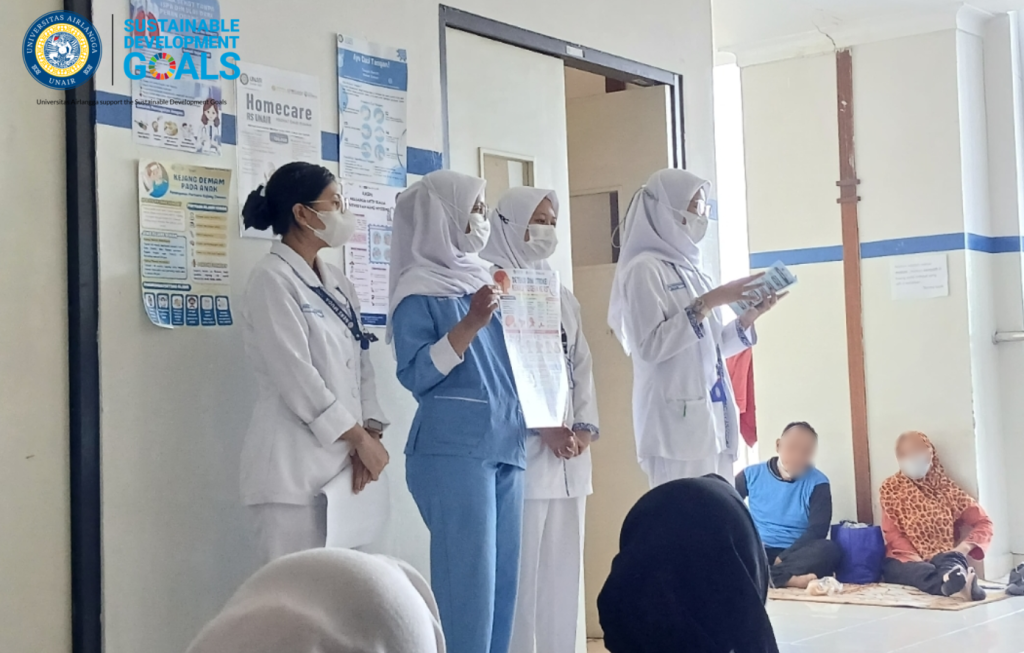
NERS NEWS — In an effort to reduce permanent disability and mortality caused by stroke attacks, a team of Nursing Profession students from the Faculty of Nursing, Universitas Airlangga, Group 3, conducted a Hospital Health Promotion (PKRS) activity entitled “Early Stroke Detection: Recognize SeGeRa Ke RS.” This educational activity was held interactively in the Intensive Care Waiting Room on the 6th Floor of Universitas Airlangga Hospital and was enthusiastically attended by families of inpatients.
Stroke remains one of the leading causes of death and disability in Indonesia. Referring to data from the Ministry of Health of the Republic of Indonesia and the Basic Health Research (Riskesdas), the prevalence of stroke continues to increase. This condition is further exacerbated by the fact that approximately 95% of first-time stroke attacks occur outside healthcare facilities or in household settings. Unfortunately, most members of the public and families do not yet have sufficient awareness and basic clinical knowledge to recognize the early signs of a brain attack. The emergency concept of “Time is Brain” emphasizes that every delay in receiving medical treatment is directly associated with the death of millions of brain cells, with the optimal treatment period or golden period occurring within 3 to 4.5 hours after symptoms begin.
To help the public recognize sudden neurological dysfunction, the team introduced the acronym “SeGeRa Ke RS” promoted by the Ministry of Health of the Republic of Indonesia. The slogan summarizes six major warning signs: Senyum tidak simetris (an asymmetrical smile or drooping face/lips), Gerak separuh tubuh melemah atau lumpuh mendadak (sudden weakness or paralysis on one side of the body), Rabatan bicara cadel/pelo atau tidak jelas (slurred or unclear speech), Kebutaan atau gangguan penglihatan mendadak (sudden blindness or visual disturbances), Rabun atau kebingungan/penurunan kesadaran mendadak (sudden confusion or decreased consciousness), and Sakit kepala hebat secara tiba-tiba yang disertai pusing berputar (sudden severe headache accompanied by vertigo). Recognizing these clinical signs is crucial so that families do not delay seeking medical treatment at the Emergency Department (ED).
In addition to recognizing symptoms, the education session emphasized evidence-based first aid measures and addressed dangerous myths commonly found in the community. Families were advised to immediately take patients to the Emergency Department, record the exact time when symptoms first appeared as a basis for thrombolysis decisions by physicians, position the patient safely while turning the head to the side if nausea or vomiting occurs, and prepare a list of medications and relevant comorbidities. Conversely, the team strongly advised against giving food or drinks due to the high risk of choking and aspiration, delaying medical treatment, or performing harmful myths such as pricking the fingers or ears with needles, which may cause infection and waste valuable treatment time.
As a closing session, participants were also provided with holistic prevention education through the “CERDIK” healthy lifestyle approach for primary prevention, consisting of Cek kesehatan rutin (regular health check-ups), Enyahkan asap rokok (eliminate cigarette smoke exposure), Rajin aktivitas fisik (regular physical activity), Diet seimbang (balanced diet), Istirahat cukup (adequate rest), and Kelola stres (manage stress), as well as the “PATUH” principle for secondary prevention among stroke survivors. Through the distribution of visual educational materials in the form of leaflets and posters, participants showed high enthusiasm during the interactive discussion session. Through this activity, patients’ families are expected to act as responsive, accurate, and alert first responders in detecting stroke and providing appropriate first aid to help save lives and preserve quality of life.
Writer: Alifiah Nabila R.





