
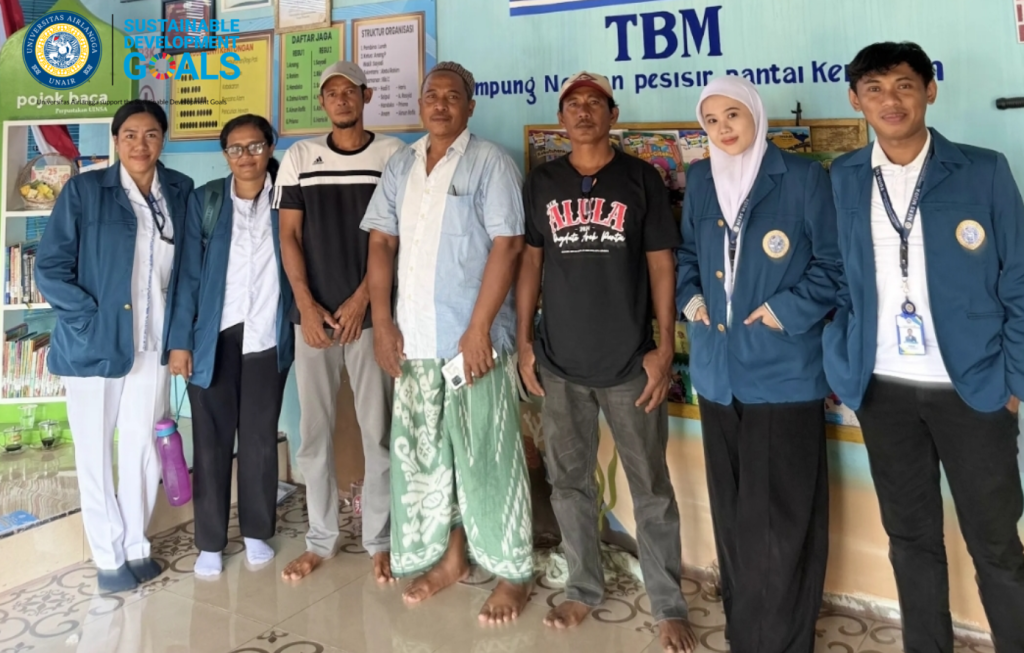
NERS NEWS — The Occupational Health Working Group of Nursing Profession students from the Faculty of Nursing, Universitas Airlangga conducted a health education activity entitled “First Aid and Basic Care Education for Fishermen in RW 03 RW 02, Sukolilo Baru Subdistrict” on Monday, August 3, 2026, from 2:00 to 3:00 p.m. The activity was aimed at fishermen in RW 02, Sukolilo Baru Subdistrict, as an effort to increase their knowledge of first aid and basic care that can be provided for health problems and occupational accidents commonly encountered during fishing activities.
The health education was conducted through lectures, discussions, and question-and-answer sessions, supported by educational media in the form of leaflets, posters, and a pocketbook on basic care that can be provided for health problems and occupational accidents. The materials covered the risk factors faced by fishermen throughout their work activities, from boat repairs, preparations for going to sea, fishing, to unloading the catch, along with potential hazards, health impacts, and preventive measures. In addition, the pocketbook provided practical guidance on first aid and basic care for various conditions commonly experienced by fishermen, such as respiratory problems, wounds, muscle pain, dermatitis, dehydration, marine animal stings, and the risk of drowning. Through this pocketbook, fishermen are expected to be able to provide appropriate initial treatment, properly use personal protective equipment (PPE), and improve their workplace safety culture in order to reduce the risk of occupational accidents and diseases and support fishermen’s productivity.
During the activity, participants showed high enthusiasm by actively following the health education session and participating in the discussion and question-and-answer sessions. Fishermen raised various questions regarding how to provide first aid for wounds, muscle pain caused by fishing activities, treatment for marine animal stings, the proper use of personal protective equipment (PPE), as well as measures to prevent occupational accidents and diseases. In addition, the fishermen also showed enthusiasm in learning how to provide basic care before receiving treatment at a healthcare facility. This demonstrated the high need for information regarding Occupational Safety and Health (OSH) and the importance of education to improve fishermen’s ability to prevent and provide initial treatment for health problems and occupational accidents.
The activity was conducted by Nursing Profession students from the Faculty of Nursing, Universitas Airlangga, under the guidance of academic and clinical advisors. The entire activity was carried out according to the planned schedule, beginning with the opening, material presentation, discussion and evaluation sessions, and concluding with the closing session. The health education lasted for 60 minutes with a systematic flow and ended with the distribution of leaflets and pocketbooks as educational materials that participants could study and practice at home. Posters were also used during the presentation to help participants better understand the educational content. Documentation of the activity was carried out as part of the reporting process.
This health education activity was motivated by the continued need to improve fishermen’s knowledge of Occupational Safety and Health (OSH), particularly in preventing occupational accidents, occupational diseases, and providing initial treatment for injuries commonly experienced during fishing activities. Limited understanding of workplace risk factors, the use of personal protective equipment (PPE), and first aid procedures can increase the risk of injuries and health problems among fishermen. Therefore, education for fishermen is expected to improve their knowledge, awareness, and skills in implementing safe work practices, using PPE appropriately, and providing first aid and basic care before receiving further treatment at healthcare facilities.
This health education activity also supported the achievement of the Sustainable Development Goals (SDGs), particularly SDG 3 (Good Health and Well-Being) through efforts to promote occupational safety and health, SDG 4 (Quality Education) through the provision of health education to working communities, SDG 8 (Decent Work and Economic Growth) through improved occupational safety and fishermen’s productivity, and SDG 17 (Partnerships for the Goals) through collaboration between educational institutions, community health centers, and the community. Overall, this activity had a positive impact on the participants and is expected to continue sustainably as a form of contribution by educational institutions to improving the health and occupational safety of fishing communities.
Writer: Shelly Fariska Dewi





