
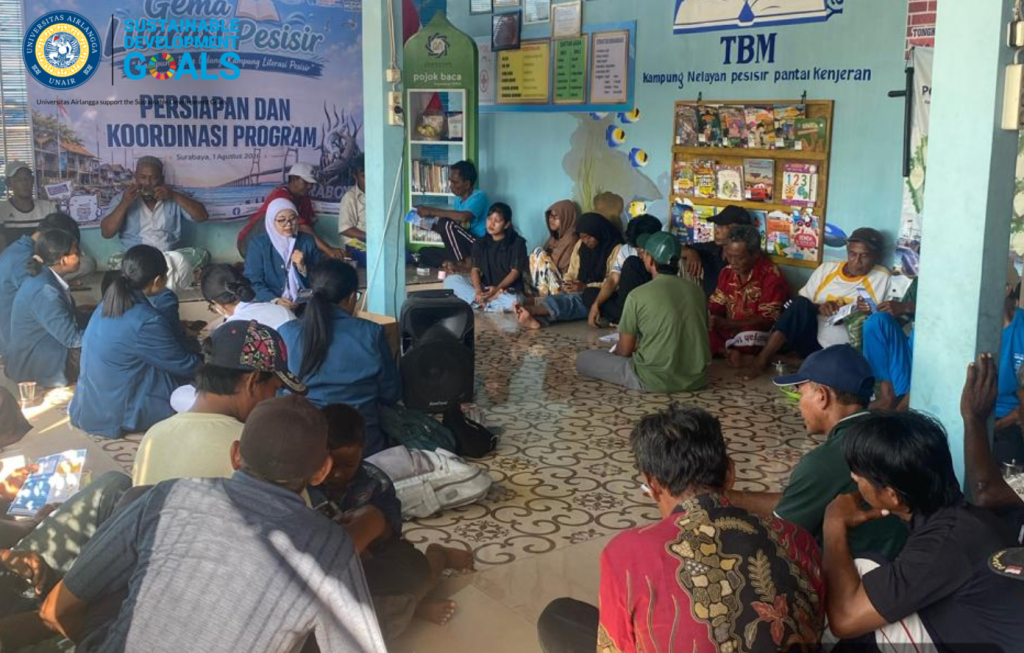
NERS NEWS — The Occupational Health Efforts Working Group (Pokja UKK) of Nursing Professional Education students from the Faculty of Nursing, Universitas Airlangga, conducted a health education activity entitled “Waste Management Education to Promote Health and Environmental Cleanliness” in RW 02, Sukolilo Baru Village, Surabaya, on Monday, August 3, 2026. The activity was aimed at residents of RW 02 as an effort to improve knowledge and awareness regarding proper waste management and the importance of maintaining environmental health and cleanliness. This activity was part of the Nursing Professional Education program in the field of community and family health nursing.
The educational session was delivered through lectures and interactive discussions supported by educational media, including leaflets and posters. The materials presented covered the definition and types of waste, waste-related problems in RW 02 of Sukolilo Baru Village, the impact of waste on public health and the environment, and proper waste management practices through the 3R principles (Reduce, Reuse, Recycle). Residents were also educated about the importance of sorting waste at home, disposing of waste in designated places, reducing the use of single-use products, and avoiding improper disposal or open burning of waste.
This educational activity was based on the findings from assessments and observations conducted during the implementation of community nursing practice in RW 02, Sukolilo Baru Village. The assessment revealed that some residents still disposed of waste improperly, including waste that eventually accumulated in coastal areas. Other issues identified included mixed waste disposal, waste accumulation, disposal of waste into waterways, and the need to increase public awareness that maintaining cleanliness is a shared responsibility.
Improper waste management can have negative impacts on both health and the environment. Piles of waste can become breeding grounds for flies, rats, cockroaches, and other disease vectors. In addition, waste can generate unpleasant odors, increase health risks, cause injuries from sharp objects, and contribute to air pollution when burned openly. From an environmental perspective, poorly managed waste can pollute soil and water, clog drainage systems, reduce environmental aesthetics, and disrupt organisms and ecosystems.
Through this educational program, residents were introduced to the implementation of the 3R principles: Reduce, which means minimizing the use of products that generate waste; Reuse, which refers to using items repeatedly if they are still suitable; and Recycle, which involves processing waste into reusable materials. Residents were also encouraged to develop the habit of sorting waste into organic, inorganic, and special waste categories. Simple practices such as bringing reusable shopping bags, using refillable water bottles, reducing single-use plastics, reusing suitable items, and channeling recyclable waste to appropriate facilities were promoted as part of waste management at its source.
During the activity, participants showed enthusiasm by actively engaging in the educational session, discussions, and question-and-answer sessions. Evaluation was conducted to assess participants’ understanding of the definition and types of waste, waste problems in the environment, the impacts of waste on health and the environment, as well as the implementation of the 3R principles and proper waste disposal habits. Participants were expected to be able to explain the material presented and apply proper waste management practices in their daily lives.
The activity was systematically organized, beginning with committee preparation, participant registration, opening remarks, material presentation, discussions and question-and-answer sessions, closing remarks, and documentation. The educational session was held at the RW 02 Community Hall in Sukolilo Baru Village, Surabaya, with assigned responsibilities among the student organizers. The lecture and interactive discussion methods were used to facilitate participants’ understanding and provide opportunities for residents to share questions and experiences related to waste management in their surroundings.
This waste management education activity is expected to increase public knowledge and awareness in maintaining environmental cleanliness and encourage the adoption of proper waste management practices starting from home. Collaborative waste management through waste reduction, sorting, reuse, recycling, and proper disposal is expected to help create a cleaner, healthier, and more comfortable environment for the residents of RW 02, Sukolilo Baru Village.
Writer: Meriyana Ate Engge





