
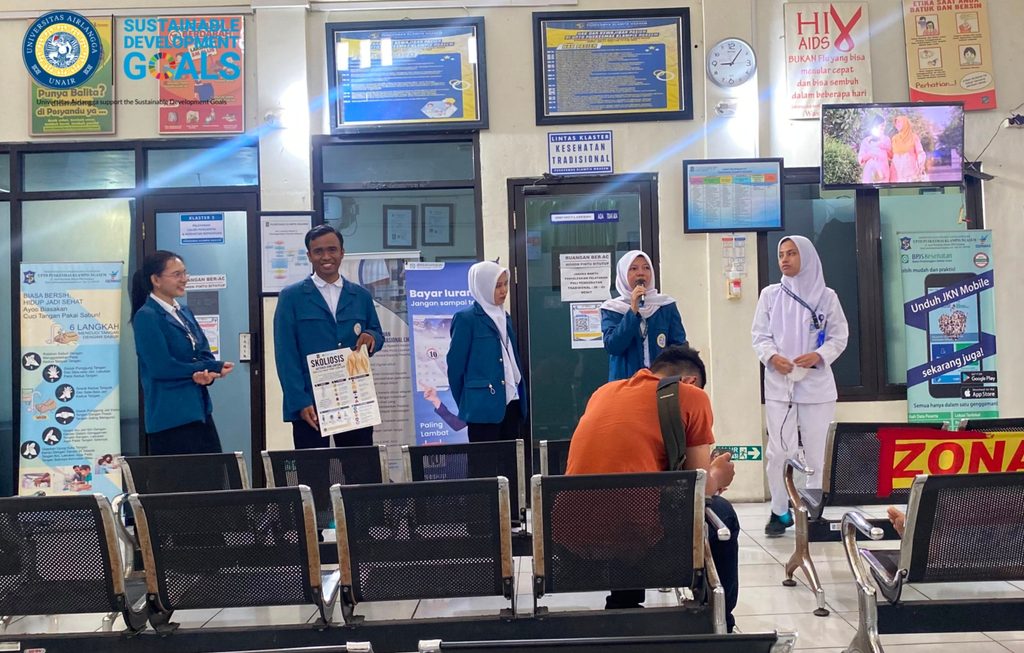
NERS NEWS — As a concrete step toward reducing the risk of postural disorders in children and adolescents, Nursing Profession Education Practice students from the Faculty of Nursing, Universitas Airlangga (Unair), held a health education and early scoliosis detection demonstration at the Waiting Room of Klampis Ngasem Community Health Center, Surabaya, on Friday (August 21). Through the activity entitled “Scoliosis: Early Detection for a Better Quality of Life,” visitors to the community health center were provided with an understanding of the early signs and symptoms of spinal abnormalities, as well as the skills to independently perform the Adam’s Forward Bend Test to prevent the condition from worsening from an early stage.
Postural disorders such as scoliosis—a condition in which the spine curves sideways, forming an ‘S’ or ‘C’ shape—often go unnoticed by the public because they generally do not cause significant pain in the early stages. In fact, the prevalence of scoliosis among adolescents is estimated to range from 2–3%, with similar findings reported in various areas of East Java and Surabaya. Delayed detection often occurs because early signs, such as uneven shoulders, an asymmetrical waist, or one shoulder blade appearing more prominent, are considered merely normal variations in body shape.
During the dynamic health education session in the waiting room of Klampis Ngasem Community Health Center, participants were provided with a comprehensive explanation of the definition, risk factors (genetic factors, congenital abnormalities, and daily postural habits that may worsen the condition), as well as the long-term impacts if scoliosis is not treated early. These impacts include chronic back pain, limitations in physical activity, and the potential for impaired lung and internal organ function in severe cases.
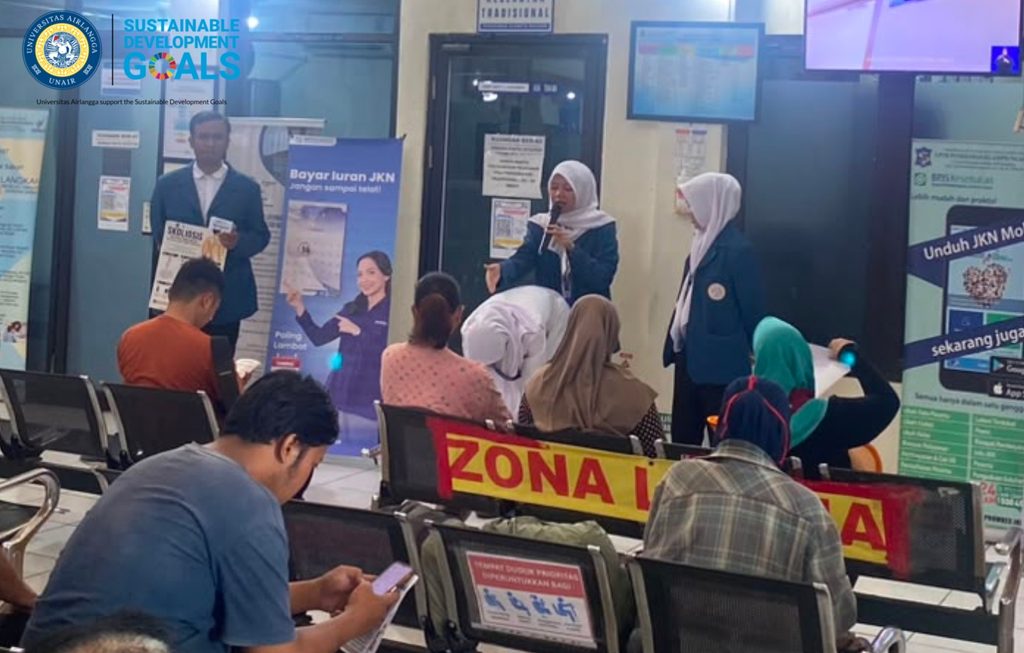
Participants not only listened to the presentation but were also directly taught how to perform a self-examination using the Adam’s Forward Bend Test. Through this simple method, parents or individuals can observe the symmetry of the back, shoulders, and ribs when the body is bent forward at a 90-degree angle. Participants showed high enthusiasm during the question-and-answer session and interactive discussion. To strengthen their understanding, the students also distributed educational leaflets and displayed visual posters emphasizing the importance of maintaining an ergonomic posture and engaging in regular exercise such as swimming.
The health education and early scoliosis detection demonstration at Klampis Ngasem Community Health Center directly supported the achievement of the Sustainable Development Goals (SDGs) through the integration of three main pillars. In realizing SDG 3 (Good Health and Well-Being), this education focused on early prevention and monitoring of spinal health to minimize progressive complications and maintain the quality of life and productivity of adolescents. This initiative also contributed to SDG 4 (Quality Education) by improving community health literacy through the delivery of structured, practical, and easy-to-understand information directly at a primary healthcare facility. All of these promotive and preventive efforts reflected SDG 17 (Partnerships for the Goals), realized through concrete synergy between higher education institutions, namely the Faculty of Nursing, Universitas Airlangga, and community healthcare facilities.
Through this early detection education and training, it is expected that the community in the working area of Klampis Ngasem Community Health Center will become more aware of postural changes in children and adolescents. Early detection is a crucial first step so that conservative treatment can be initiated more quickly before the curvature becomes more severe. If signs of postural asymmetry are found in children, the community is encouraged to immediately consult and undergo further examination at the nearest healthcare facility.
Writer: Ahfa Putri Amelia





