
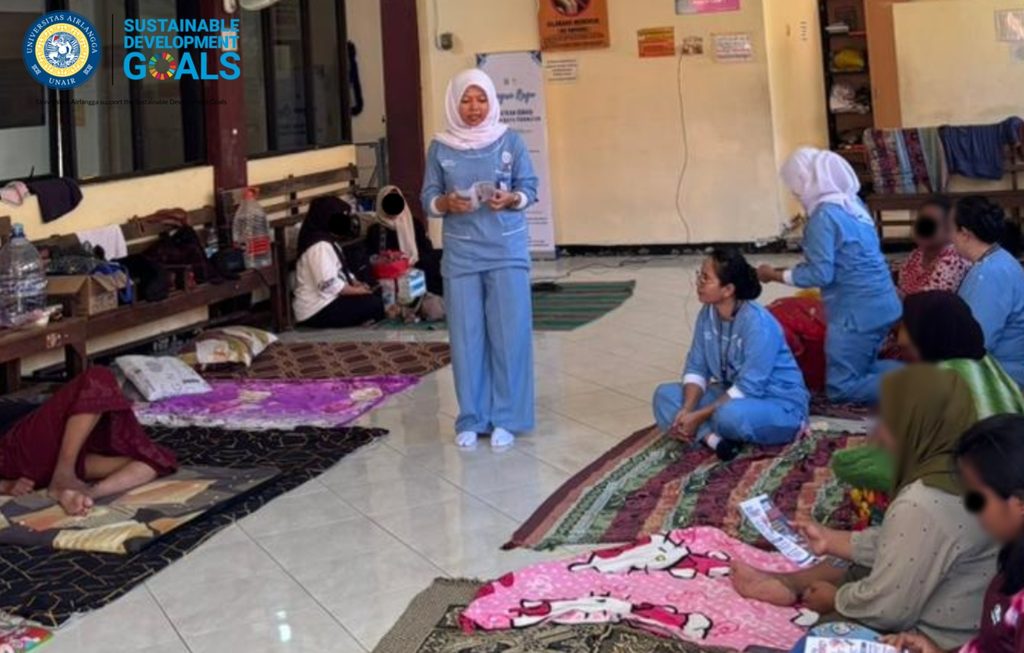
NERS NEWS — Nursing Profession students of Universitas Airlangga conducted a Hospital Health Promotion (PKRS) activity with the theme “Recognition and Management of Code Stroke for Patients’ Families” on Friday, August 28, 2026, in the family waiting room of HCU Aster, RSUD Dr. Soetomo. This activity aimed to increase families’ knowledge and preparedness in recognizing the signs and symptoms of stroke early, understanding the concept of Code Stroke, knowing the importance of the patient’s Last Known Well, and understanding the family’s role in accelerating the management of stroke patients.
This health education activity focused on improving patients’ families’ understanding of stroke as an emergency condition that requires prompt and appropriate management. The materials presented included the definition of stroke, types of stroke, signs and symptoms of stroke, reasons why stroke must be treated immediately, the concept of Code Stroke, and the general stroke management process.
The students also introduced a simple way to recognize the signs of stroke through the B.E. F.A.S.T. method, namely Balance (balance problems), Eyes (vision problems), Face (facial asymmetry), Arm (arm weakness), Speech (speech difficulties), and Time (the importance of seeking help immediately). Families were encouraged to immediately seek medical assistance if they found these signs and to record the last time the patient was known to be in a normal condition.
In addition to B.E. F.A.S.T., participants received education about the SeGeRa Ke RS method, which consists of Senyum tidak simetris (asymmetrical smile), Gerak separuh anggota tubuh melemah tiba-tiba (sudden weakness in half of the body), Bicara pelo atau gangguan bicara (slurred speech or speech difficulties), Kebas atau kesemutan separuh tubuh (numbness or tingling in half of the body), Rabun atau gangguan penglihatan tiba-tiba (sudden blurred vision or vision problems), and Sakit kepala hebat yang muncul tiba-tiba (sudden severe headache). This method is used as a reminder for families to recognize signs that may indicate stroke and immediately take the patient to the hospital.
During the health education session, the students also explained Code Stroke as a rapid and coordinated response system for patients suspected of experiencing an acute stroke. Families were also given an understanding of the importance of Last Known Well, which is the last time the patient was known to be in a normal condition. This information is one of the important pieces of information that needs to be conveyed to healthcare workers because it can help determine the management of acute stroke.
Not only regarding symptom recognition, participants also received education about what families should and should not do. Families were advised to remain calm, immediately call for help, remember the last time the patient was normal, and provide information about the patient’s medical history and medications. Conversely, families were advised not to wait for the symptoms to disappear, give the patient food or drinks, administer medication independently, massage the patient as a substitute for medical assistance, or move the patient without necessity or instructions from healthcare workers.
The activity was conducted using lectures, discussions, and question-and-answer sessions, with educational media in the form of leaflets and posters. A total of 13 participants took part in the activity and showed high enthusiasm throughout the health education session. The question-and-answer session was interactive, with various questions regarding the signs and symptoms of stroke, the golden period, and initial actions to take when a stroke occurs.
The participants’ enthusiasm was evident when several families asked questions about stroke conditions that occur suddenly and the actions that should be taken when someone suddenly falls. The students explained the importance of checking the patient’s level of consciousness and breathing, calling for help, and not giving the patient food or drinks.
Based on the evaluation of the activity, participants demonstrated improved understanding of the definition of stroke, its signs and symptoms, the golden period, and initial management when a stroke occurs. Most participants also actively participated in the question-and-answer session, especially when discussing how to recognize the signs and symptoms and the initial management of stroke.
This PKRS activity supports several goals of the Sustainable Development Goals (SDGs), particularly:
SDG 3: Good Health and Well-Being
Education on the recognition and management of Code Stroke contributes to increasing families’ knowledge and preparedness in dealing with stroke emergencies. Understanding the signs and symptoms of stroke and the importance of prompt treatment is expected to help reduce delays in receiving assistance and support patient safety.
SDG 4: Quality Education
Health education is one form of health education for the community, particularly patients’ families. Through the delivery of information about stroke using lectures, discussions, question-and-answer sessions, as well as leaflets and posters, families gain knowledge that can help them play an active role in the patient’s care process.
Through the activity “Recognition and Management of Code Stroke for Patients’ Families,” Nursing Profession students of Universitas Airlangga hope that families will become more capable of recognizing the signs of stroke early and understand the importance of receiving immediate medical assistance. Increased family knowledge is expected to support the rapid, appropriate, and coordinated management of patients, while also increasing family involvement in care and the prevention of recurrent stroke.
Writer: Rinda Purnama Sari





