
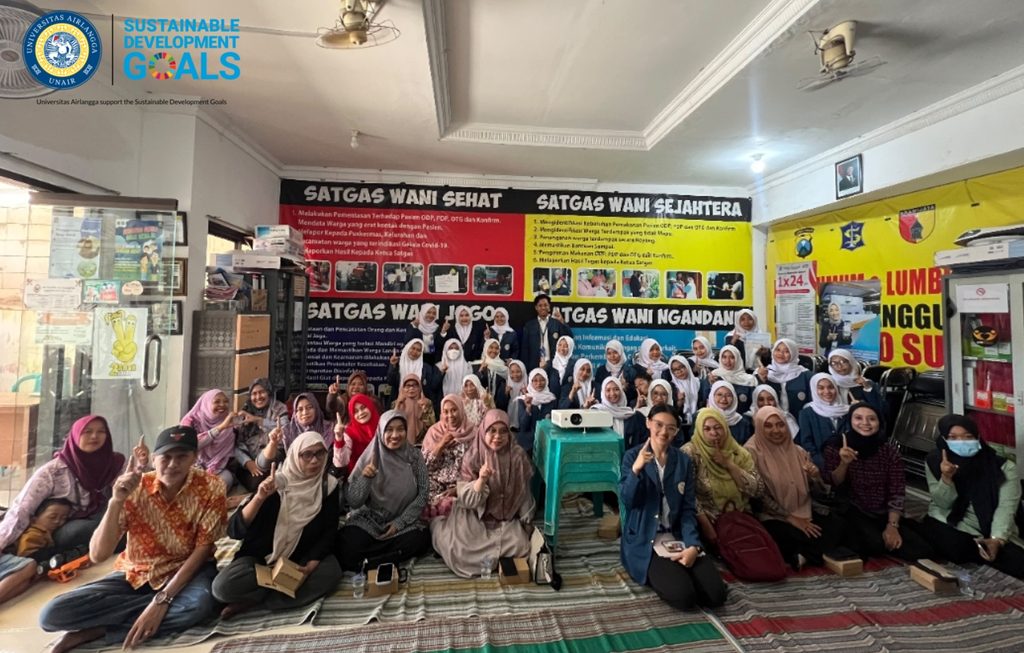
NERS NEWS — Nursing Profession Education students of the Faculty of Nursing, Universitas Airlangga (FKp Unair), Wave 2, conducted an Initial Dissemination Activity on the Identification and Prioritization of Community Health Problems in RT 03, RT 04, and RT 05 of RW 01, Gebang Putih Subdistrict, Sukolilo District, Surabaya. This activity was conducted as a follow-up to the community assessment carried out by the students to identify various health problems in the community and serve as a basis for developing interventions appropriate to the community’s needs.
The dissemination activity was attended by local community officials, health cadres, academic supervisors, clinical supervisors, and community representatives. During the activity, the students presented and clarified the results of the community assessment conducted from August 29 to September 2, 2026. The assessment was conducted through interviews (key informant interviews), observation (windshield survey), documentation studies (secondary data), and focus group discussions (FGD) involving the Head of RW, Heads of RT, Head of PKK, Surabaya Hebat Cadres (KSH), healthcare workers from Klampis Ngasem Community Health Center, and residents of RT 03, RT 04, and RT 05 of RW 01. The previous FGD was conducted on August 31, 2026, with representatives of cadres, Heads of RT, the Head of RW, residents, and representatives from Klampis Ngasem Community Health Center.
The assessment results presented included demographic and general community data, community subsystem data such as physical environmental conditions, health-related behaviors, transportation, and community activities, as well as specific data based on age groups, including mothers and toddlers, school-age children, adolescents, productive-age adults, and older adults. All of these data were then analyzed to determine community nursing diagnoses, followed by problem screening to establish the priority problems that would become the focus of the intervention.
Based on the assessment results, several main health problems were identified, namely ineffective health management, characterized by low rates of routine health examinations and adherence to treatment. In addition, risky health behaviors were identified, such as smoking habits, lack of physical activity, and unhealthy lifestyles. Another problem was ineffective environmental health maintenance, indicated by low waste-sorting practices and the continued presence of rats, insects, and mosquito larvae around the home environment.
The activity was conducted interactively through presentations, question-and-answer sessions, and discussions. One response was given by the Head of RT 03, who stated that the assessment and dissemination activities provided an overview of the conditions of the community in the area, including the health conditions of its residents. According to him, these activities enabled local community officials to better understand the characteristics and health conditions of the people living in their neighborhood.
The discussion also addressed findings related to the community’s drinking water sources. The Head of RT 03 stated that this information needed to be known by the RT so that it could be followed up according to the community’s conditions, either through education or the necessary forms of assistance. In response, Neisya Pratiwindya Sudarsiwi, S.Kep., Ns., M.Kep., explained that the selection of drinking water sources needed to be further assessed through an approach to the community. Surabaya Hebat Cadres and RT officials need to understand the reasons why residents choose these drinking water sources so that education can be provided appropriately, particularly regarding the risks and impacts on health.
Through this initial dissemination activity, Nursing Profession students of FKp Unair Wave 2, together with the community and stakeholders, were able to establish a shared understanding of the health conditions in RW 01 Gebang Putih. The results of the activity will subsequently serve as a basis for determining priority problems and developing community nursing interventions that are appropriate to the needs and conditions of the community. Thus, the interventions provided are expected to be more targeted and involve active community participation.
Writer: Danella Aura Shifa





