
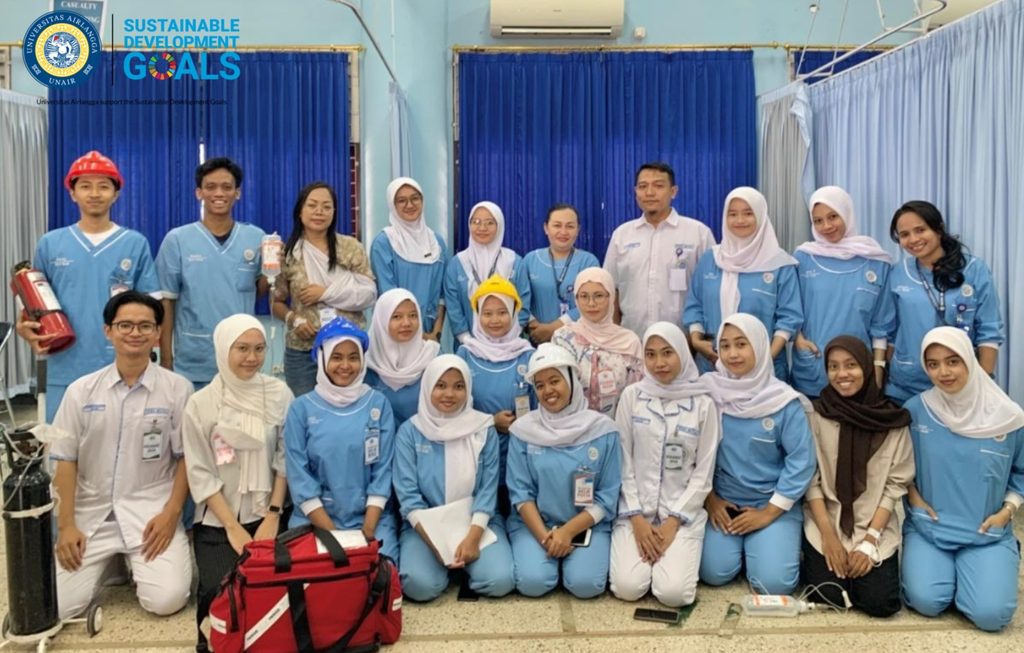
NERS NEWS — Universitas Airlangga Nursing Profession Students of Batch 48, Second Wave, Emergency, Critical, and Disaster Nursing Rotation, conducted a simulation activity on emergency response to an electrical short circuit and the implementation of the Code Red SOP in the Melati Inpatient Ward of RS A on Monday, August 3, 2026, at 09:00 a.m. This activity aimed to improve knowledge, preparedness, skills, and coordination abilities in responding to fires in the hospital environment quickly, appropriately, systematically, and in a coordinated manner.
The simulation activity was conducted as a form of learning and preparedness improvement in responding to non-medical emergencies in the hospital environment, particularly fires that may occur due to electrical short circuits. Fire conditions in hospitals can threaten the safety of patients, patients’ families, staff, visitors, and the continuity of healthcare services. Therefore, a rapid and coordinated response system is required through the implementation of Code Red.
In this activity, students demonstrated a fire scenario that began with an electrical short circuit in the Melati Inpatient Ward on the second floor of RS A. The simulation depicted a situation in which a staff member discovered smoke, electrical sparks, and a small fire originating from one of the electrical outlets. The incident was then reported to other staff members as an initial step in activating the emergency response system.
Students also demonstrated the process of activating Code Red as the hospital’s response system to a fire incident. Code Red is an emergency code used to identify, inform, and activate a response to a fire or a condition that has the potential to cause a fire in the hospital environment. The implementation of this system aims to ensure that all staff understand the type of emergency and immediately carry out actions according to their respective roles and responsibilities.
In addition to Code Red activation, the simulation demonstrated the use of a Light Fire Extinguisher (APAR) as an initial firefighting effort. In the simulated SOP, the use of the fire extinguisher was carried out using the TATS method (Tarik, Arahkan, Tekan, Sapukan — Pull, Aim, Press, Sweep). If the fire could not be controlled, the Head of the Ward activated the Code Red Team to assist with the firefighting and fire response according to the situation.
Another important aspect demonstrated was the process of patient rescue and evacuation. In the scenario, patients in the ward with their families were evacuated with the assistance of staff using a wheelchair or stretcher according to the patient’s condition. Families were also accompanied throughout the evacuation process to ensure their safety until they reached the assembly point.
After the patients and families were evacuated, a final check of the room was conducted to ensure that no patients, family members, or staff were left behind. The inspection was also carried out to ensure that the evacuation route was safe to use. Subsequently, all patients, families, and staff were directed to the designated assembly point.
At the final stage of the simulation, data collection was conducted for patients, families, and staff who had arrived at the assembly point. The data collection aimed to ensure that no individuals were left inside the building and to ensure that the area was safe. After this process was completed, the simulation was closed by the Head of the Ward by expressing appreciation to all team members because the Code Red procedure had been carried out until all members reached the assembly point safely.
The simulation involved various roles, ranging from nurses on duty, the Head of the Ward, patients, patients’ families, security personnel, to the Code Red Team, which used helmets according to assigned duties. The division of roles was designed to illustrate coordination among staff in responding to a fire incident in the inpatient ward.
The implementation of the simulation was also supported by various facilities and equipment, including a fire extinguisher (APAR), fire alarm, telephone or mobile phone for communication with the Code Red Command Post, wheelchair, stretcher, Code Red Team helmets, evacuation signs or routes, vests or staff identification badges, and patient beds. In addition, patient and family data collection sheets and simulation evaluation forms were used.
Through this activity, students are expected to understand the definition and causes of electrical short circuits, recognize early signs of potential fires, understand the risks of fires to patient safety and the hospital environment, and explain and implement the Code Red SOP flow. Students are also expected to be able to perform initial response actions, use fire extinguishers, rescue and evacuate patients, and establish effective communication and coordination during emergency response.
The simulation activity on emergency response to electrical short circuits and the implementation of the Code Red SOP supports several goals of the Sustainable Development Goals (SDGs), particularly:
SDG 3: Good Health and Well-Being
This activity supports the creation of a safe healthcare environment by improving preparedness in responding to fires in hospitals. The ability to recognize incidents, activate the Code Red system, carry out initial firefighting, and evacuate patients appropriately can help protect the safety of patients, families, staff, and hospital visitors.
SDG 4: Quality Education
The simulation serves as a form of practice-based learning for Nursing Profession students to improve their knowledge and skills in responding to emergencies in the hospital environment. This activity provides a learning experience through direct demonstrations of Code Red activation, initial firefighting, team coordination, evacuation, and data collection at the assembly point.
Through the simulation activity on emergency response to electrical short circuits and the implementation of the Code Red SOP, Universitas Airlangga Nursing Profession students are expected to become increasingly prepared to face non-medical emergency conditions in the hospital environment. This activity not only improves their understanding of Code Red procedures but also trains their communication, coordination, initial firefighting, rescue, and structured patient evacuation skills.
The implementation of the simulation is expected to serve as a valuable learning experience for students while supporting the development of a safety culture in the hospital environment. With preparedness and the proper implementation of procedures, the risks of injury, facility damage, and disruption to patient safety caused by fires can be minimized.
Writer: Rinda Purnama Sari





