
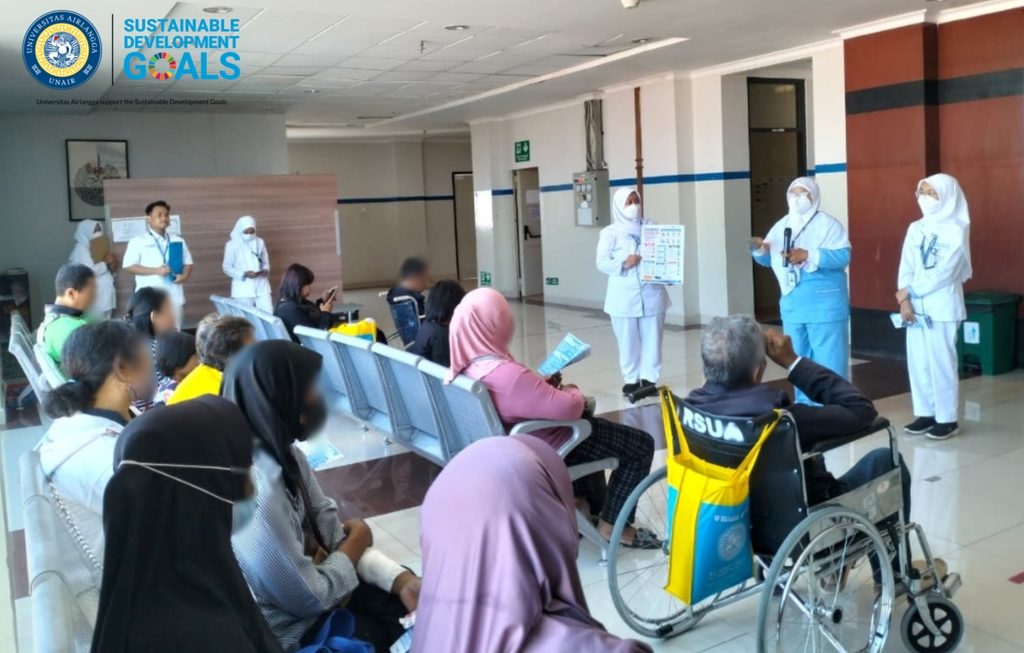
NERS NEWS — Nursing Profession Education Program students from Batch 49, Odd Semester 2026/2027, Faculty of Nursing, Universitas Airlangga, successfully conducted a Hospital Health Promotion (PKRS) activity on Friday (September 11, 2026). This community service activity was carried out in the Hemodialysis Unit of Universitas Airlangga Hospital (RSUA), focusing on the topic “Education on Fluid Restriction Adherence to Prevent Intradialytic Hypertension in Hemodialysis Patients.”
The 60-minute activity was initiated by Group 1 of Batch 49 under the guidance of academic advisor Dr. Ika Yuni Widyawati, S.Kep.Ns., M.Kep., Ns.Sp.Kep.MB., and clinical supervisor Erna Kustiyaningsih, S.Kep., Ns. This health education aimed to provide in-depth understanding to hemodialysis (HD) patients and accompanying family members regarding the importance of fluid control to prevent intradialytic hypertension, namely the phenomenon of a paradoxical increase in blood pressure that occurs during or immediately after the dialysis process.
The event began at 10:00 a.m. Western Indonesian Time (WIB), led by Andini Irdiana Putri, S.Kep. as the moderator, who opened the activity, introduced the nursing profession student team members, and conveyed the learning objectives. The material session was presented clearly and communicatively by the presenters, Aqso Al Falistin, S.Kep. and Nonie Decyeka, S.Kep. In their presentation, the presenters explained that one of the main triggers of intradialytic hypertension is fluid volume overload due to patients’ lack of adherence to limiting their daily intake. Significant fluid removal by the dialysis machine when there is excess body fluid can excessively activate the sympathetic nervous system and the Renin-Angiotensin-Aldosterone System (RAAS), ultimately triggering a spike in blood pressure.
“Many patients do not yet realize that fluids do not only come from drinking water, but also include foods with broth, ice, juice, milk, and fruits with high water content. If these intakes are not controlled, the workload of the heart and blood vessels will increase drastically during the dialysis process,” explained the presenting team to the participants.
To facilitate understanding, the nursing profession student team also distributed leaflets and utilized informative posters containing practical tips for reducing daily thirst. Several simple steps taught included regularly maintaining oral hygiene and gargling, using cold compresses, sucking on small ice cubes that are still counted as part of the daily fluid allowance, and consuming mint-flavored candy.
The activity concluded with an evaluation of participants’ understanding by the moderator, the presentation of rewards for active participants, and a group photo session documented by Sabrina Restu Maharani, S.Kep., under the observation of the event by Kurnianingtyas Novikasari M., S.Kep. Through this education, patients and families are expected to be able to apply the information independently at home so that the risk of cardiovascular complications due to intradialytic hypertension can be reduced.
Writer: Andini Irdiana Putri





