
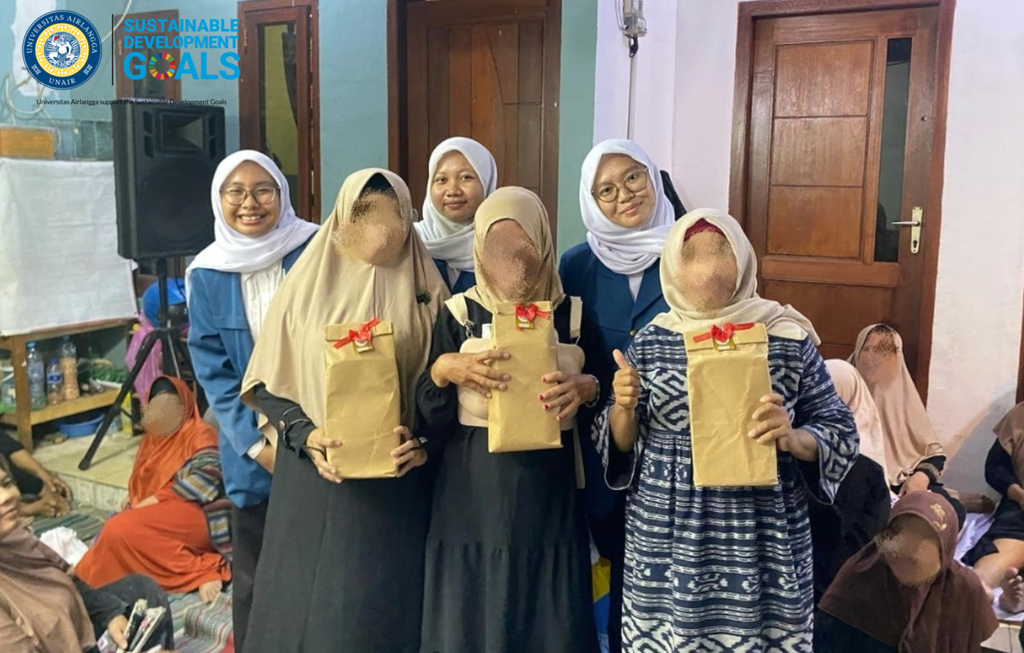
NERS NEWS — Efforts to increase women’s awareness of breast health are an important step in supporting the early detection of breast cancer. One effort that can be carried out is through regular and proper Breast Self-Examination (SADARI). As a form of health education and promotion in the community, Nursing Profession Education Practice students of the Faculty of Nursing, Universitas Airlangga, Groups 1, 2, and 3, Community and Family Nursing Rotation at Kalijudan Community Health Center, conducted a health education activity entitled “Care for Your Breasts: SADARI Movement for Healthy and Empowered Women.” The activity was conducted on Wednesday, September 16, 2026, at 6:30 p.m. WIB, after the women’s religious gathering in RW 07, Dukuh Sutorejo, in front of Mrs. Tina’s house, targeting women of reproductive age in RW 07, Dukuh Sutorejo.
This activity was conducted under the guidance of Clinical Supervisor Waji, S.Kep., Ns., as well as Academic Supervisors Dr. Makhfudli, S.Kep., Ns., M.Ked.Trop., Prof. Ferry Efendi, S.Kep., Ns., M.Sc., Ph.D., and Dr. Eka Mishbahatul Mar’ah Has, S.Kep., Ns., M.Kep. The health education aimed to increase the knowledge and awareness of women of reproductive age regarding breast cancer, the importance of early detection, and the ability to perform SADARI correctly and routinely every month.
During the activity, participants were provided with an understanding of breast cancer or carcinoma mammae, namely a malignant tumor that develops in breast tissue and can spread to surrounding tissues and other organs of the body. Breast cancer is one of the types of cancer that commonly occurs in women. This condition requires attention because, in its early stages, breast cancer often does not cause pain, so changes in the breasts may go unnoticed. Therefore, monitoring breast conditions and early detection are important parts of efforts to recognize abnormalities at an early stage.
Participants were also provided with education about breast cancer risk factors, consisting of modifiable and non-modifiable factors. Modifiable factors include obesity, alcohol consumption, smoking habits, stress, and exposure to carcinogenic substances. Meanwhile, non-modifiable factors include genetic or hereditary factors, sex, age, pregnancy history, menstrual history, and breastfeeding history. Understanding these various risk factors is expected to increase women’s awareness of breast health.
In addition to risk factors, participants were provided with an understanding of the signs and symptoms of breast cancer that need attention. Some changes that may be found include the appearance of lumps in the breast or armpit, changes in breast shape and size, changes in the nipples, as well as changes in the breast skin such as wrinkles, redness, or a feeling of warmth. In more advanced conditions, signs such as arm swelling, skin wounds, bone pain, weight loss, shortness of breath, or other symptoms due to disease spread may occur.
The educational activity then continued with a demonstration of the steps for performing SADARI using a breast phantom. Participants were taught to stand in front of a mirror and observe changes in the shape, size, skin color, wrinkles, or indentations of the breasts. The examination continued by raising both arms and observing changes in the breasts and nipples, then placing the hands on the waist while observing the condition of the breasts. Participants were also taught to palpate using their fingertips slowly over the entire breast area up to the armpit area with circular movements, from top to bottom, and from the edge of the breast toward the nipple.
After the palpation examination, participants were taught to examine the condition of the nipples by gently applying pressure and observing whether any discharge was present. If abnormal changes or repeated nipple discharge were found, participants were directed to consult a doctor or healthcare professional for further examination. SADARI was also performed in a lying position by placing a pillow under the shoulder and raising the arm, followed by palpation of the entire breast area again.
In addition to SADARI, participants were also introduced to several breast cancer screening and early detection methods, such as Clinical Breast Examination (SADANIS), thermography, and mammography. This information was provided so that participants would know that early detection can be carried out through self-examination as well as examination by healthcare professionals according to individual needs.
The activity was conducted through lectures, demonstrations, and question-and-answer sessions. The media used included leaflets and a breast phantom to help participants understand the material and directly practice the steps of SADARI. Participants were given the opportunity to practice the examination that had been demonstrated so that they were expected not only to understand the material theoretically but also to be able to perform SADARI sequentially and correctly.
Through the “Care for Your Breasts: SADARI Movement for Healthy and Empowered Women” activity, women of reproductive age in RW 07, Dukuh Sutorejo, are expected to increasingly understand the importance of maintaining breast health and performing SADARI regularly every month. This activity is also expected to encourage women to be more aware of changes in their breasts and immediately utilize healthcare services if they find suspicious signs or abnormalities, so that early detection can be carried out and treatment can be provided according to their condition.
Writer: Fila Andrianti Safia





