
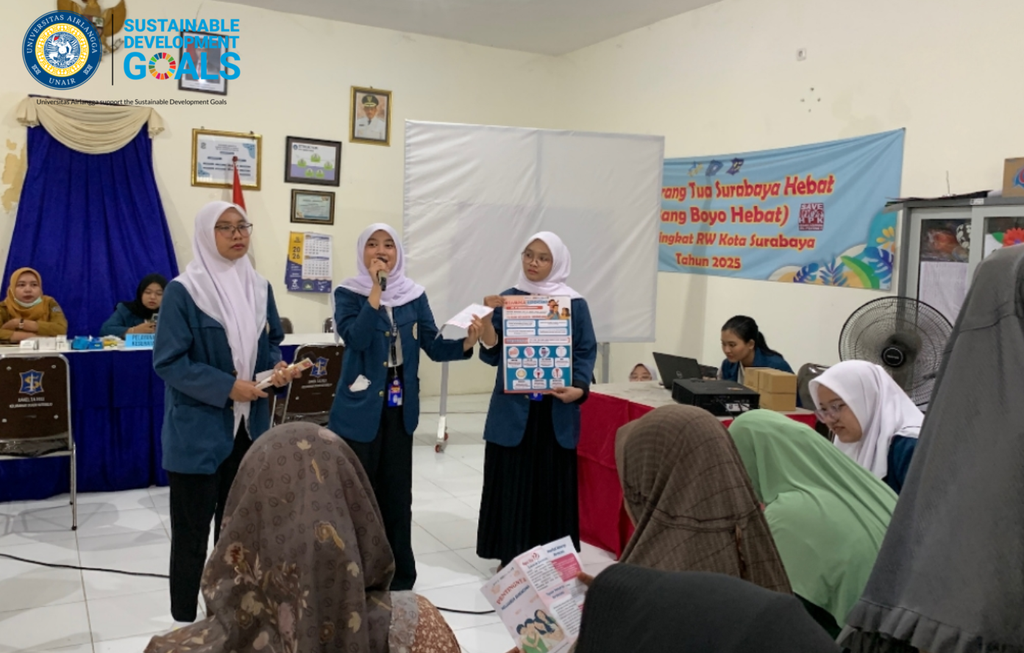
NERS NEWS — Efforts to improve reproductive health among couples of reproductive age are an important step in creating healthy, prosperous, and quality families. One effort that can be made is through pregnancy planning and the appropriate use of contraception. As a form of health education and promotion in the community, Nursing Profession Education Practice students of the Faculty of Nursing, Universitas Airlangga, Groups 1, 2, and 3, Community and Family Nursing Rotation at Kalijudan Community Health Center, conducted a health education activity entitled “The Importance of Family Planning (KB) in Creating Healthy and Prosperous Families.” The activity was conducted on Tuesday, September 8, 2026, at the RW 07 Community Hall, Dukuh Sutorejo, Mulyorejo District, Surabaya City, targeting women of reproductive age in RW 07, Dukuh Sutorejo.
This activity was conducted under the guidance of Clinical Supervisor Waji, S.Kep., Ns., as well as Academic Supervisors Dr. Makhfudli, S.Kep., Ns., M.Ked.Trop., Prof. Ferry Efendi, S.Kep., Ns., M.Sc., Ph.D., and Dr. Eka Mishbahatul Mar’ah Has, S.Kep., Ns., M.Kep. The health education aimed to increase participants’ knowledge and understanding regarding the importance of using family planning to plan pregnancies, space births, determine the number of children, and choose contraceptive methods appropriate to the conditions and needs of couples.
During the activity, participants were provided with an understanding of family planning and contraception. Family planning is an effort to help married couples manage their reproductive lives, including regulating the number, spacing, and timing of pregnancies through the use of contraceptive methods. Meanwhile, contraception refers to methods, devices, or medications used to prevent or regulate pregnancy. The choice of contraceptive method needs to be adjusted to reproductive goals, health conditions, age, number of children, medical history, breastfeeding conditions, and user comfort.
Participants were also provided with education on the importance of pregnancy planning. Pregnancy requires physical, mental, social, and financial preparation. In planning a pregnancy, couples need to consider age and fertility, health conditions, access to healthcare services, support in childcare, socioeconomic conditions, the number of children they already have, and the interval since the previous pregnancy. This planning is expected to help couples determine the timing and number of pregnancies according to their family’s conditions.
The educational activity also discussed the goals and benefits of family planning for mothers, infants and children, families, and communities. The use of family planning can help prevent unintended pregnancies, space pregnancies, provide mothers with time to recover after childbirth, and support optimal breastfeeding and childcare. For families, pregnancy planning can help prepare for children’s educational and healthcare needs and adjust the number of children to the family’s capacity.
In addition to the benefits of family planning, participants were introduced to various types and methods of contraception, ranging from long-term contraceptive methods such as IUDs, implants, tubectomy, and vasectomy to short-term methods such as contraceptive injections, birth control pills, and condoms. Participants also received information about natural methods, such as the Lactational Amenorrhea Method (LAM), fertility awareness methods, and withdrawal. Each method has different advantages, limitations, effectiveness, and requirements for use, so the choice needs to consider the reproductive conditions and goals of each couple.
One important message delivered was that contraceptive selection should be carried out through counseling with healthcare professionals or through informed choice. Before determining a method, couples need to consider the purpose of family planning, health conditions, medications currently being taken, previous contraceptive use, and information regarding possible side effects. By obtaining adequate information, couples can make contraceptive choices that are more appropriate to their individual needs and conditions.
The education also emphasized that family planning consultations can be conducted at various stages of reproductive life, starting before marriage, before planning a pregnancy, during pregnancy, before childbirth, after childbirth, during breastfeeding, after menstruation returns, after miscarriage, when wanting to change methods, or when no longer wanting to have children. Breastfeeding mothers were also provided with an understanding that breastfeeding does not always prevent pregnancy and that the Lactational Amenorrhea Method (LAM) can only be used when all of its requirements are met.
The educational activity was conducted through interactive lectures, discussions, question-and-answer sessions, as well as pre-tests and post-tests to assess participants’ understanding before and after the material was provided. The media used included posters and leaflets containing information about the definition and goals of family planning, the benefits of contraception, and various types of contraception along with their advantages and limitations. The leaflets were given to participants so that the information obtained during the activity could be reviewed independently at home.
Through the “The Importance of Family Planning (KB) in Creating Healthy and Prosperous Families” activity, women of reproductive age in RW 07, Dukuh Sutorejo, are expected to increasingly understand the importance of pregnancy planning and the use of appropriate contraception. This education is also expected to increase couples’ awareness of utilizing family planning services, regulating the number and spacing of pregnancies, and making reproductive decisions based on accurate information and counseling from healthcare professionals. Thus, the family planning education program is expected to support the creation of healthy, quality, and prosperous families and contribute to improving maternal and child health.
Writer: Fila Andrianti Safia





