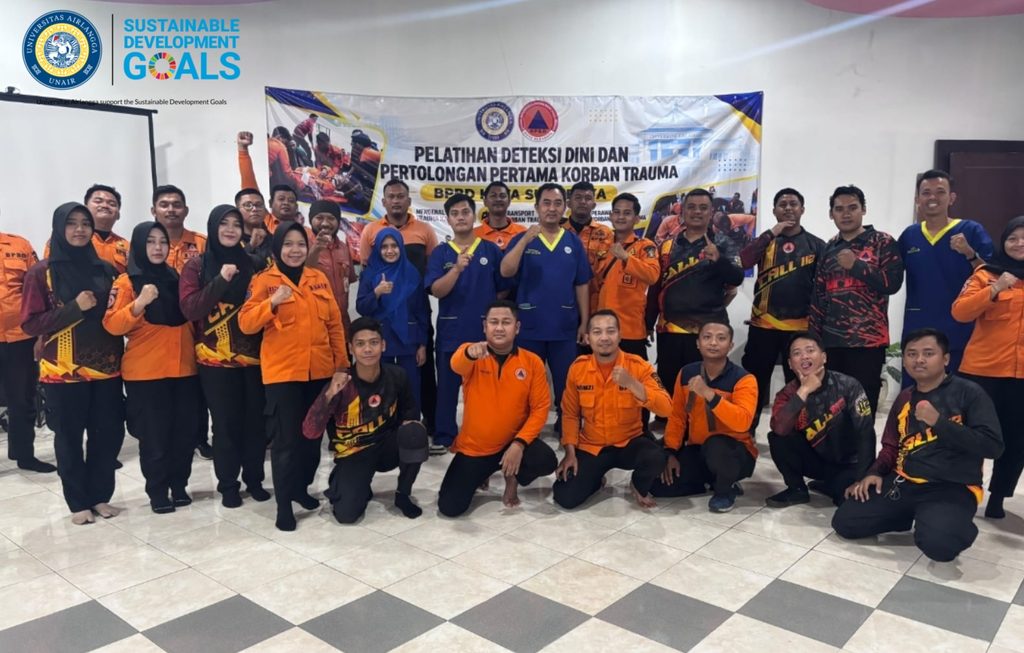
Surabaya City BPBD personnel alongside the community service team from the Faculty of Nursing Unair during the emergency management training session. (Doc. Community Service Team)
NERS NEWS — The Nursing Specialist Study Program, Faculty of Nursing, Universitas Airlangga (Unair) Class of 7, organized a community service activity titled “Realizing a Safe and Secure Community through Enhancing BPBD Personnel Skills in Emergency Management” on Thursday, October 29, 2026, at the Regional Disaster Management Agency (BPBD) of Surabaya City, Jalan Jemursari Timur II No. 2, Surabaya. Attended by 30 Surabaya City BPBD personnel, this program aimed to strengthen knowledge, preparedness, and first aid skills through education, demonstrations, skill practices, and trauma victim handling simulations.
The series of events began with a joint prayer, followed by welcoming remarks from the Head of Surabaya City BPBD. Following the opening, participants took a pre-test to assess their baseline knowledge of emergency management. This stage served as part of the activity evaluation as well as a benchmark to measure participants’ comprehension after completing the education and training sessions.
The agenda continued with educational presentations. Ns. Arif Setiawan, S.Kep., M.Kep delivered material on early detection and first aid for patients with head trauma (trauma capitis), as well as bandaging, splinting techniques, and post-trauma wound care. Subsequently, Ns. Tiara Kudri, S.Kep., M.Kep presented on victim transportation and safe helmet removal procedures for post-trauma victims. These materials were provided to reinforce participants’ understanding of initial assessment, rescuer and victim safety principles, and proper first aid actions.
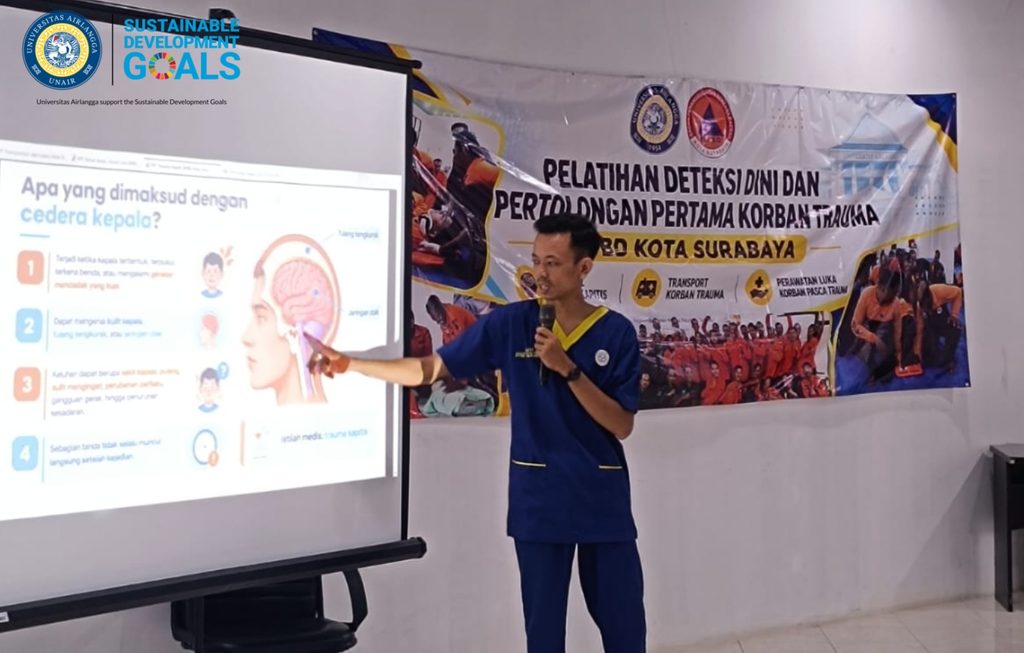
Presentation of early detection and first aid material for head trauma by the speaker. (Doc. Community Service Team)
After the lecture session and a break, participants engaged in a hands-on skill session supervised by the instructor team. The practical exercises covered bandaging and splinting, post-trauma wound care, helmet removal, as well as the moving and transportation of trauma victims. Through demonstrations and direct practice, participants had the opportunity to apply first aid steps in accordance with the materials previously delivered.
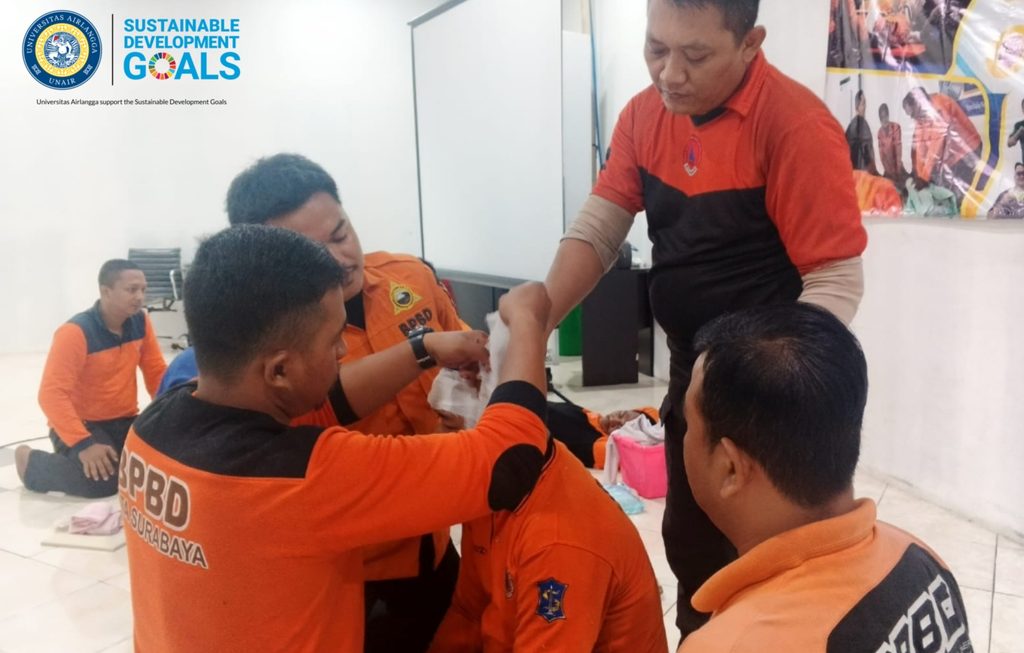
Participants practicing first aid procedures under instructor supervision. (Doc. Community Service Team)
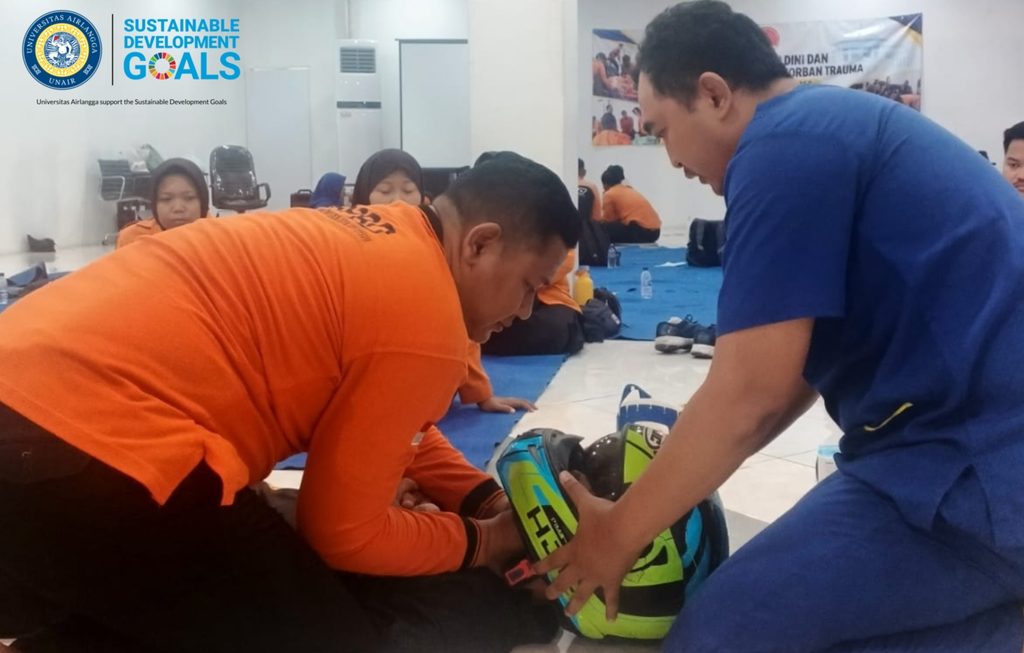
Safe helmet removal practice on post-trauma victims under instructor supervision. (Doc. Community Service Team)
At the conclusion of the event, participants completed a post-test and a skill reinforcement evaluation. This assessment was conducted to review participants’ comprehension after receiving the materials while solidifying the practical skills trained. This entire series of activities was carried out by the community service team of the Nursing Specialist Study Program, Faculty of Nursing Unair Class of 7, led by Dr. Abu Bakar, Ns., M.Kep., Sp.Kep.MB as Chairperson, and Dr. Sriyono, Ns., M.Kep., Sp.Kep.MB as Person in Charge.
This community service initiative supports the achievement of the Sustainable Development Goals (SDGs), particularly SDG 3: Good Health and Well-Being, by strengthening first aid capacity to help improve the safety of emergency victims. The activity also aligns with SDG 4: Quality Education, as it provides structured learning and skills training through lectures, demonstrations, and hands-on practice. Additionally, the collaboration between the Faculty of Nursing Unair and Surabaya City BPBD reflects support for SDG 17: Partnerships for the Goals.
Through this initiative, the Faculty of Nursing Unair strives to contribute to building the capacity of Surabaya City BPBD personnel as one of the key elements involved in initial emergency response. The knowledge and skills gained are expected to be applied accurately, swiftly, and safely according to field requirements. Moving forward, ongoing education and refresher training programs are expected to continue sustainably to support the realization of a safe and secure society (Safe Community).
Writer: Arif Setiawan