
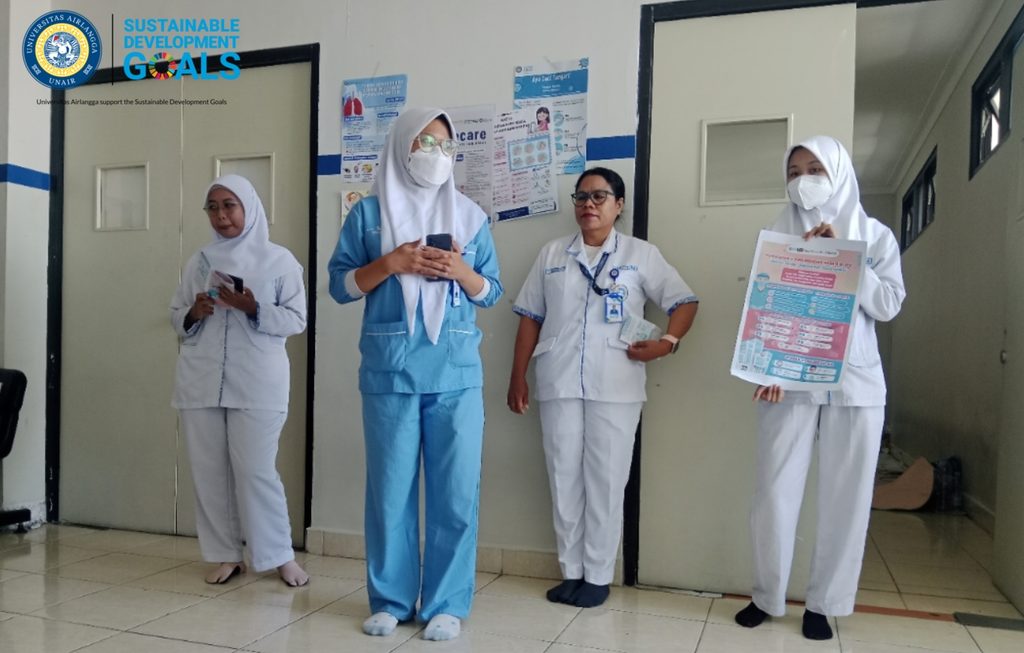
NERS NEWS — Nursing Profession Education Program students of the Faculty of Nursing, Universitas Airlangga, conducted a Hospital Health Promotion (PKRS) activity as part of an effort to increase patients’ families’ awareness of Infection Prevention and Control (IPC) in the intensive care environment. The activity, conducted by Group 5 of the Emergency, Critical, and Disaster Nursing Rotation, took place on Friday, August 28, 2026, in the Intensive Care Waiting Room, targeting patients’ families and companions.
This educational activity was conducted to increase families’ understanding of the importance of infection prevention while staying in the ICU environment. Patients receiving intensive care are more vulnerable to infection because they are in critical condition, experience decreased immunity, and frequently use various invasive medical devices that can serve as entry points for microorganisms. Therefore, the involvement of families and visitors in implementing infection prevention practices is an important part of maintaining patient safety.
The materials presented included the definition of infection, ways germs are transmitted in hospitals, the importance of hand hygiene, the six steps of handwashing, the five moments for hand hygiene, cough and sneeze etiquette, and ICU visiting rules. Participants were given an understanding that infections can spread through direct contact, indirect contact through contaminated objects, or through droplets or the air when someone coughs, sneezes, or talks.
The PKRS activity was conducted interactively through lectures, discussions, and demonstrations of hand hygiene practices. The presenter demonstrated the six correct steps of handwashing, after which participants were given the opportunity to follow and practice them directly. In addition, participants were also invited to understand the five important moments for performing hand hygiene, including before and after contact with patients and after touching the environment around patients.
The education also discussed the implementation of cough and sneeze etiquette to reduce the risk of droplet transmission in the hospital environment. Participants were reminded to wear masks, cover their nose and mouth with a tissue or the inside of their elbow when coughing and sneezing, dispose of tissues after use, and perform hand hygiene. Understanding these simple actions is expected to help families contribute to maintaining a safe care environment.
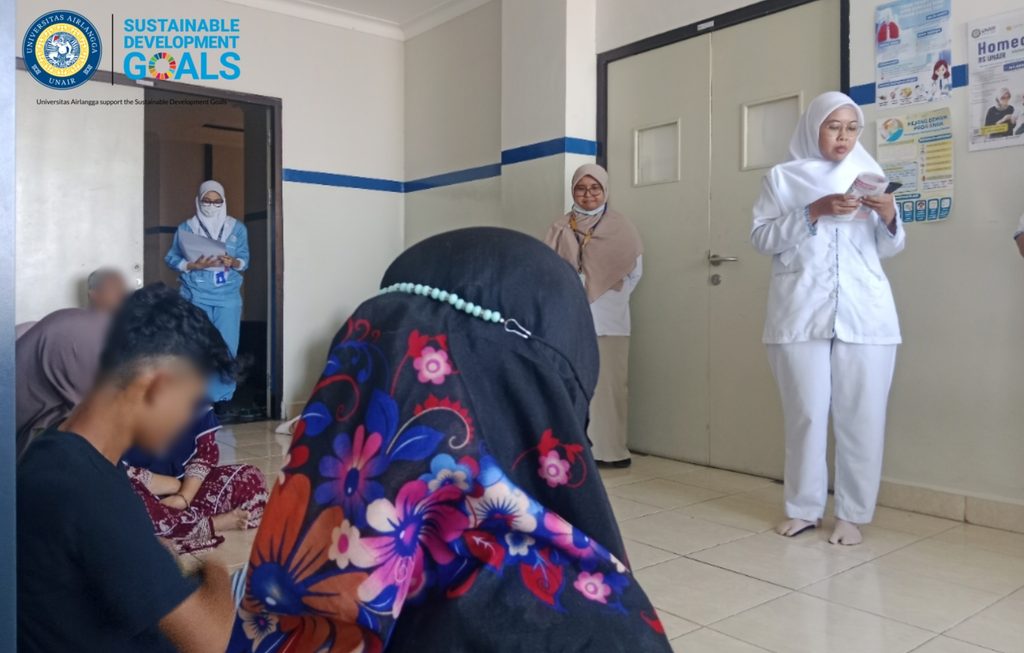
In addition to individual behavior, compliance with ICU visiting rules was also part of the education. Families were given information regarding restrictions on visiting times and the number of visitors, the use of masks or PPE according to regulations, the prohibition of visiting when sick, and the importance of maintaining cleanliness in the ICU environment. These rules are necessary to minimize exposure to microorganisms from outside and help break the chain of infection transmission.
During the activity, participants attended the health education session and were involved in the discussion and evaluation sessions. The presenter asked several questions to assess participants’ understanding, including why ICU patients are more vulnerable to infection, when hand hygiene should be performed, and how to apply cough and sneeze etiquette. Participants were also asked to demonstrate the hand hygiene steps again as part of the skills evaluation.
The PKRS activity was supported by educational posters and leaflets containing information about how infections spread, the impact of infections on ICU patients, the six steps of handwashing, the five moments for hand hygiene, cough and sneeze etiquette, and ICU visiting rules. The use of these media is expected to help participants recall the materials presented and apply them while accompanying patients.
Through this activity, Nursing Profession students also encouraged family involvement in Infection Prevention and Control efforts in the ICU. Practicing hand hygiene, applying cough and sneeze etiquette, and complying with visiting rules are simple steps that families can take to help protect patients, themselves, and the surrounding environment from the risk of infection transmission.
This PKRS activity also supports the achievement of the Sustainable Development Goals (SDGs), particularly SDG 3: Good Health and Well-Being through increasing families’ awareness of infection prevention and patient safety, SDG 4: Quality Education through providing health education that can be understood and practiced directly, and SDG 17: Partnerships for the Goals through the involvement of students, healthcare workers, and families in supporting a safe care environment.
Overall, the Infection Prevention and Control education activity in the ICU is one of the students’ efforts to strengthen the role of families in maintaining safety during the care process. The knowledge gained is expected not to stop at the health education activity but to be applied through the habit of maintaining hand hygiene, practicing cough and sneeze etiquette, and complying with visiting regulations while in the hospital environment.
Writer: Group 5 of the Emergency, Critical, and Disaster Nursing Rotation, Second Wave





