
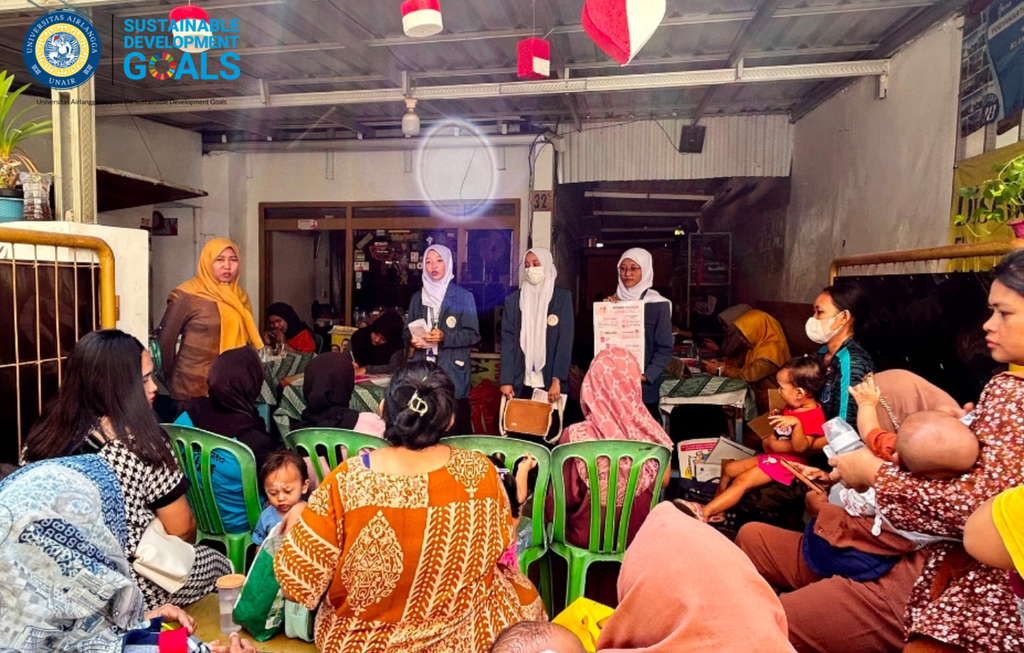
NERS NEWS — Nursing Profession students of the Faculty of Nursing, Universitas Airlangga, conducted a health education activity entitled “Breast Self-Examination and Clinical Breast Examination Education as an Effort for Early Detection of Breast Cancer” in RT 01 RW 02, Klampis Ngasem Urban Village, Sukolilo District, Surabaya, as part of the Family Posyandu (POSGA) activity held on Monday (September 14, 2026) at 9:00 a.m. WIB. This activity was one form of health education for the community that was in line with Sustainable Development Goal (SDG) 3: Good Health and Well-Being, through efforts to increase knowledge and awareness regarding the importance of early detection of breast cancer.
This health education was organized by Unair Nursing Profession students and targeted residents consisting of women who were participating in the Family Posyandu activity. The activity was moderated by Rimma Murti, while the material was presented by Sindy Rahma Maisaroh and Nur Laila Maulida. Through this activity, the students sought to increase participants’ understanding of how to detect the onset of breast cancer early.
The materials provided included the definition of breast self-examination and clinical breast examination, the purpose of the examinations, the steps for performing breast self-examination, and the appropriate time to perform breast self-examination. The presenters explained that breast self-examination is an examination of the breasts that can be performed routinely to recognize changes in the breasts early. The community also needs to understand that changes such as lumps, changes in the shape or size of the breasts, skin changes, inverted nipples, or abnormal discharge from the nipples need to be examined further. In addition, clinical breast examination is performed by healthcare professionals as a clinical examination to detect breast abnormalities so that further treatment can be provided if suspicious signs are found.
The material was delivered interactively through a lecture method and question-and-answer session. Participants were given the opportunity to ask questions about breast self-examination and clinical breast examination. Participants appeared enthusiastic and asked several questions related to the early detection of breast cancer through breast self-examination and clinical breast examination. This health education activity is expected to increase community awareness and knowledge, particularly among women, regarding the importance of early detection of breast cancer. With better understanding, participants are expected to be able to perform early detection of breast cancer independently and immediately seek assistance from healthcare services if they find signs and symptoms suggestive of breast cancer.
Writer: Nandika Amelia Dewi Pratama





