
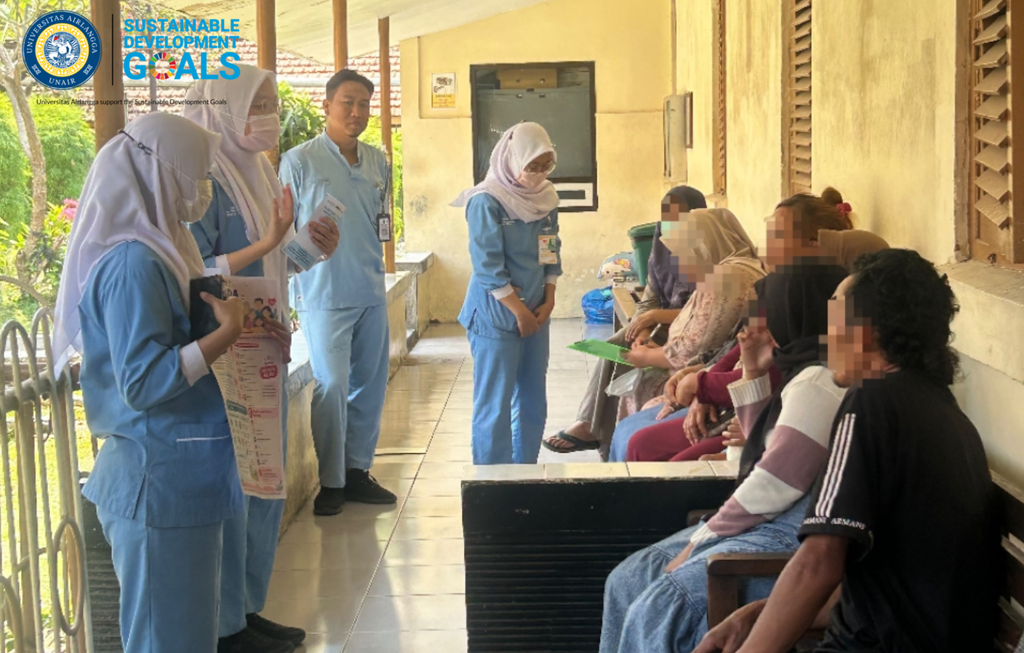
NERS NEWS — Surabaya, September 18, 2026 – Nursing Professional Education Program students from the Faculty of Nursing, Universitas Airlangga, conducted a Hospital Health Education (PKRS) activity entitled “Stroke Awareness: Recognize, Prevent, and Support” in the waiting room of the Aster HCU at Dr. Soetomo Regional General Hospital, Surabaya, on Friday (September 18, 2026). The activity, held from 10:00 to 10:30 a.m. Western Indonesia Time (WIB), was attended by 14 patients’ family members.
The activity was conducted by Group S2.3 of the Nursing Professional Education Program, Faculty of Nursing, Universitas Airlangga, under the academic supervision of Dr. Arina Qona’ah, S.Kep., Ns., M.Kep., and clinical supervision by Susi Purwati, S.Kep., Ns.
This educational activity aimed to improve families’ understanding of stroke, ranging from recognizing the condition and warning signs that may precede a stroke, identifying the signs and symptoms of recurrent stroke, understanding the immediate actions that should be taken, to implementing various measures to prevent recurrent stroke. Families were also provided with an understanding of their role in supporting post-stroke patients after returning home.
Stroke is a medical emergency that occurs when blood flow to the brain is disrupted, either due to a blockage or rupture of a blood vessel. For patients who have previously experienced a stroke, awareness of recurrent symptoms is important so that medical assistance can be provided as soon as possible. Temporary neurological symptoms, such as those occurring in a Transient Ischemic Attack (TIA), should also not be ignored, as they may serve as a warning sign of an impending stroke.
Using posters and leaflets, participants were encouraged to recognize stroke warning signs through the simple “SEGERA KE RS” guide. Warning signs include sudden facial drooping or asymmetry, weakness or numbness on one side of the body, slurred speech or difficulty speaking, visual disturbances, and impaired balance. If these signs appear suddenly, families were reminded not to wait for the symptoms to disappear on their own and to immediately take the patient to a healthcare facility.
In addition to recognizing warning signs, patients’ families received education on preventing recurrent stroke through risk-factor management. The measures emphasized included taking medication as prescribed by healthcare professionals, attending regular check-ups, maintaining blood pressure, blood glucose, and cholesterol levels, adopting a healthy diet, engaging in physical activity according to the patient’s abilities, and avoiding smoking.
The role of the family was also one of the main focuses of the educational session. Families are expected to help remind patients about medication and check-up schedules, accompany them during activities and rehabilitation, provide motivation throughout the recovery process, and create a safe home environment for patients. Families should also be able to recognize the signs of recurrent stroke so that they can take immediate action when a medical emergency occurs.
Participants’ enthusiasm was evident throughout the discussion and question-and-answer session. Various questions were raised based on conditions previously experienced by the participants or their family members. Among the questions were those concerning numbness in the limbs and its association with stroke, leg stiffness and heel pain after stroke, fingers that are difficult to straighten after gripping, as well as headaches and neck pain associated with high blood pressure.
One participant who had previously experienced a stroke also asked about ways to prevent another stroke attack. During the discussion, participants were given an understanding that preventing recurrent stroke does not depend solely on medication, but also requires risk-factor management, lifestyle changes, regular health check-ups, and consistent family support.
The evaluation conducted at the end of the activity showed that participants were able to explain the definition of stroke in simple terms and recognize several warning signs that require attention. Participants also understood the importance of immediately taking patients to the hospital when signs of stroke appear and were able to identify several measures to prevent recurrent stroke and explain the role of the family in supporting patients throughout the recovery process.
Through the “Stroke Awareness: Recognize, Prevent, and Support” activity, the students hope that families will become better prepared to play an important role in stroke patient care. The knowledge gained is expected to be applied in daily life, from helping patients adhere to treatment and maintain a healthy lifestyle to taking prompt action when signs of stroke recur.
Writer: Ahmad Zubair Al Mahdi





