
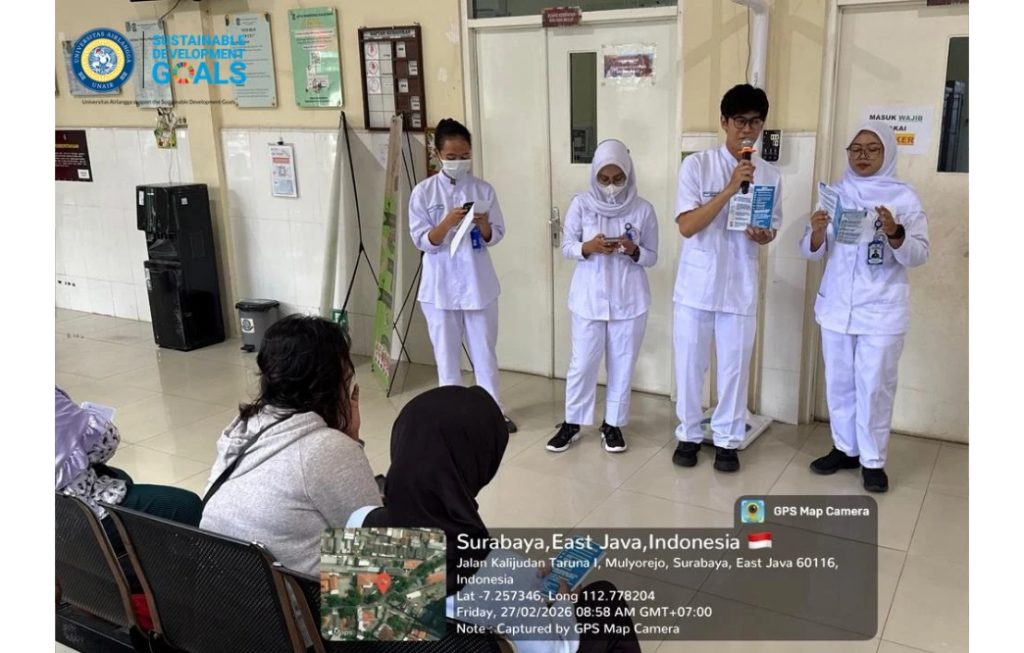
NERS NEWS – Surabaya – A health education session on diarrhea was held on Friday, February 27, 2026, at the Kalijudan Community Health Center in Surabaya. This activity was organized by students from the Airlangga University Faculty of Nursing, class A3 groups A3 and A4, class of 2023, using lectures, interactive discussions, and hand washing demonstrations using leaflets as media. This health education program aims to enhance public understanding and awareness in recognizing symptoms, preventing, and providing initial home care for diarrhea to minimize the risk of dehydration and complications, particularly in infants and children, while promoting the adoption of clean and healthy living behaviors.
This activity is also part of the support for the achievement of the Sustainable Development Goals (SDGs), especially SDG 3 on Good Health and Well-being through improving the quality of public health, and SDG 4 on Quality Education through strengthening education and health literacy in a sustainable manner. This activity was accompanied by our clinical supervisor Waji, S.Kep., Ns. and academic supervisor Dr. Eka Misbahatul Mar’ah Has, S.Kep., Ns., M.Kep. The enthusiasm of the participants was evident from their activeness during the question and answer session, their involvement in the demonstration, and their participation in a brief evaluation at the end of the activity. Through this activity, students from the Faculty of Nursing, Airlangga University, hope that the community can understand and apply the correct preventive measures and treatment for diarrhea at home, so that the risk of complications can be minimized and the health of families can be improved.
The outreach activity was held on Friday, February 27, 2026, and began at 8:40 a.m. with an opening ceremony. At 8:45 a.m., the presentation of material on diarrhea continued, covering the definition of diarrhea as three or more loose bowel movements per day, types of acute and chronic diarrhea, causes of infection by bacteria, viruses, and parasites, the risk of dehydration, and seven warning signs that require immediate medical attention, such as weakness, inability to drink, continuous vomiting, bloody stools, high fever, infrequent urination, and sunken eyes. Next, at 08:52, a demonstration of the six steps of hand washing with soap was conducted as a form of prevention against the transmission of diarrhea, and the participants actively followed the hand washing movements that were demonstrated. The activity continued with a question and answer session from 08:55 to 09:00, where several participants actively asked questions, including about the assumption that one should not eat fruits and vegetables when having diarrhea, whether one danger sign is already considered diarrhea, and the administration of oral rehydration solution to one-month-old babies. The questions asked by the participants were answered well by the presenter.
The outreach activity was held on Friday, February 27, 2026, and began at
The activity concluded with a reinforcement of the material at 9:00–9:05 a.m. by the academic advisor, Ms. Eka, who emphasized the importance of proper diarrhea treatment and the administration of oral rehydration solution as recommended by health workers. The education provided is not merely temporary knowledge but can be consistently applied within the family environment. With increased awareness and proper handwashing habits, the risk of diarrhea transmission can be reduced, thereby maintaining the health of family members. The small commitment made together today is expected to have a significant impact on improving the health status of the community in the future.





