
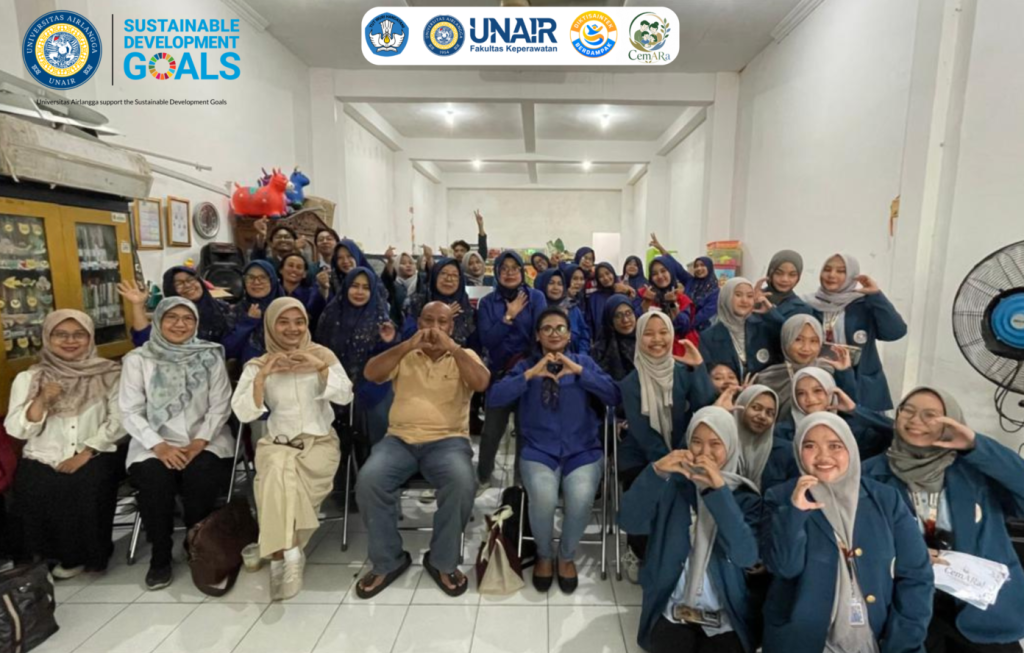
NERS NEWS — On Friday, May 22, 2026, an Integrated Project-Based Learning (PJBL) activity in Pediatric Nursing, Maternity Nursing, and Psychosocial and Cultural Aspects in Nursing was conducted under the theme “(CEMARA!) Smart Family Management for Healthy Children and Prosperous Parents” at the RW 08 Community Hall, Bratang Binangun, Baratajaya Village, Gubeng District, Surabaya. This activity was a form of community service and health education organized by Group 3, Class A2, Cohort 2024 students from the Faculty of Nursing, Universitas Airlangga.
The activity was attended by approximately 25 participants, the majority of whom were mothers and local community members. The event began with participant registration, an opening session, welcoming remarks from the supervising lecturer and the Head of RW 08, followed by a pre-test to assess participants’ baseline knowledge. Participants then received education on the role of nutrition and breast care in supporting successful exclusive breastfeeding among postpartum mothers. The materials covered the basic concepts of the postpartum period, nutrition for breastfeeding mothers, breast care, breast massage, proper breastfeeding techniques and positions, as well as psychological and sociocultural factors that influence breastfeeding success.
In the following session, participants received education on preventing Gerakan Tutup Mulut (GTM) or feeding refusal through appropriate complementary feeding practices and psychoculturally based feeding rules. The materials included the importance of introducing complementary foods according to the child’s age, ensuring balanced nutritional intake, understanding feeding rules, the Baby-Led Weaning (BLW) method, and strategies for managing children who experience feeding refusal. The education was delivered interactively through lectures, demonstrations, discussions, and role-playing activities, enabling participants to gain a more practical understanding of the topics presented.
Throughout the activity, participants demonstrated high enthusiasm by actively engaging in demonstrations, question-and-answer sessions, and other interactive activities. Based on the evaluation results from the pre-test and post-test, there was an increase in participants’ understanding of the importance of exclusive breastfeeding, postpartum care, appropriate complementary feeding practices, and parenting approaches that support children’s health and development.
Through this activity, it is hoped that the residents of RW 08, Baratajaya Village, will enhance their knowledge and skills in managing family health, supporting the success of exclusive breastfeeding, implementing appropriate feeding practices for children, and creating a healthy, harmonious, and prosperous family environment.
Author: Jelena Hardiani
Editor: Nandyta Putri Rahmadhani (Airlangga Nursing Journalist)





