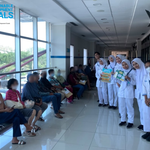
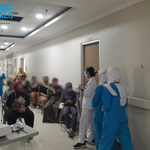
NERS NEWS — Emergency situations require rapid, accurate, and coordinated responses. This was one of the experiences gained by students of the Nursing Profession Program, Faculty of Nursing, Universitas Airlangga (Unair), through a Code Blue simulation conducted at Universitas Airlangga Hospital (RSUA) on Friday, August 14, 2026.
The activity, held at the Dharmawangsa Hall on the 8th Floor of RSUA from 1:00 to 4:00 p.m., was part of the Emergency, Critical, and Disaster Nursing Rotation. Through a scenario designed to resemble an emergency situation in a hospital, students had the opportunity to practice the management of a patient experiencing cardiac arrest.
The simulation began when a staff member found the patient unresponsive. After conducting an initial assessment, the staff member immediately initiated resuscitation and activated the Code Blue system. The secondary team then arrived with emergency equipment to continue the management together with the primary team. During the process, students carried out their assigned roles, including airway management, ventilation, patient monitoring, defibrillator use, and administration of pharmacological therapy according to the cardiac arrest management algorithm. Each intervention was performed in a coordinated manner, with effective communication among team members as a key priority.
The ability to work systematically in a situation requiring a rapid response was one of the aspects trained during the simulation. Clear communication, task delegation, and accurate decision-making played an important role in ensuring that each intervention could be carried out effectively. After the series of interventions was performed according to the established procedures, the simulated patient achieved Return of Spontaneous Circulation (ROSC). The patient was then prepared for further management and monitoring in the intensive care unit.
Ns. Yogo Apriyanto, S.Kep., M.Kep., as the person in charge of the Code Blue Simulation at Universitas Airlangga Hospital, stated that continuous training is necessary to help students become accustomed to situations requiring rapid intervention. According to him, simulation also provides an opportunity to develop communication and teamwork skills, which play an important role in managing critically ill patients.
Meanwhile, Erna Dwi Wahyuni, S.Kep., Ns., M.Kep., as the Person in Charge of the Course (PJMK) for the Emergency, Critical, and Disaster Nursing Rotation, expressed her hope that the experience would help students connect theoretical learning with clinical practice. Readiness in terms of knowledge, skills, and mental preparedness is expected to serve as an important foundation for students when facing emergency situations in healthcare settings.
Through the Code Blue simulation, students not only practiced clinical interventions but also learned the importance of role delegation, communication, coordination, and decision-making in critical situations. This experience is expected to strengthen students’ competence and confidence in carrying out their professional roles as nurses.
Writer: Dea Wahidah Rahmadani