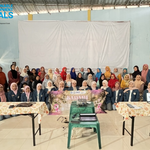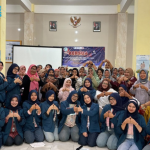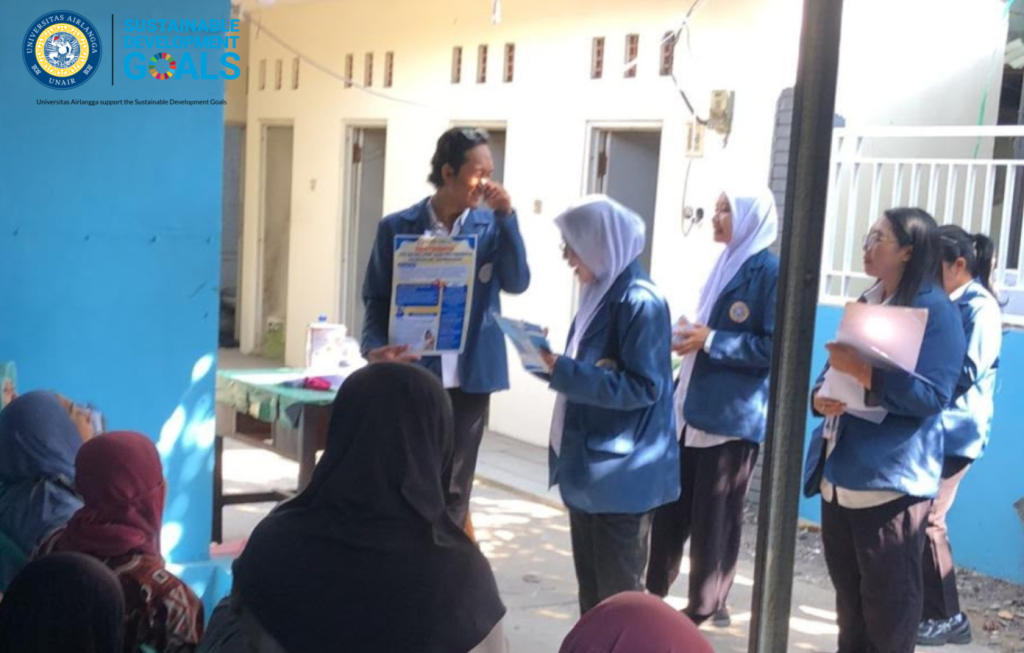
NERS NEWS – The Maternal and Child Health Working Group (Pokja KIA) of Nursing Profession students from the Faculty of Nursing, Universitas Airlangga conducted a health education session with the theme “The Importance of Exclusive Breastfeeding and Supplementary Feeding (PMT)” at Posyandu Sukolilo Baru in the Kenjeran Community Health Center area on Saturday, August 1, 2026, from 09:00 to 10:00 a.m. The activity targeted pregnant women as well as mothers with infants and toddlers as an effort to increase their knowledge about the importance of exclusive breastfeeding during the first six months of an infant’s life and the appropriate provision of complementary feeding (MP-ASI) to support children’s growth and development.
The health education session was conducted through lectures, discussions, and question-and-answer sessions supported by educational media in the form of leaflets, posters, and a PMT pocketbook containing recipes using local food ingredients. The materials presented included the definition of exclusive breastfeeding, the benefits of breastfeeding for mothers and infants, proper breastfeeding techniques, the importance of exclusive breastfeeding for the first six months, the appropriate time to start complementary feeding (MP-ASI), the principles of providing nutritionally balanced complementary foods, and the importance of Supplementary Feeding (PMT) in supporting the nutritional status of infants and toddlers. In addition, participants received education on utilizing local food ingredients as accessible, affordable sources of nutrition that can be processed into healthy complementary food menus through a pocketbook containing various local food recipes. This education is important because appropriate exclusive breastfeeding and complementary feeding are among the efforts to prevent stunting, strengthen children’s immunity, and support optimal growth and development.
Throughout the activity, participants showed high enthusiasm by actively following the education session and participating in discussions and question-and-answer sessions. Various questions were raised regarding how to overcome breastfeeding difficulties, selecting nutritious foods for complementary feeding, and processing local food ingredients into attractive menus that meet the nutritional needs of infants and toddlers. This demonstrated the high need for information regarding appropriate feeding practices for infants and toddlers.
The activity was conducted by Nursing Profession students from the Faculty of Nursing, Universitas Airlangga under the guidance of academic and clinical supervisors. The entire series of activities proceeded according to the planned schedule, beginning with the opening, material presentation, discussion and evaluation sessions, and closing. The education session lasted for 60 minutes with a systematic flow and concluded with the distribution of leaflets and a PMT pocketbook containing local food recipes as educational materials that participants could study and practice at home. Posters were also used during the presentation to help participants understand the educational content. Documentation of the activity was carried out as part of the reporting process.
This health education session was motivated by the continuing need to improve public knowledge regarding appropriate exclusive breastfeeding and complementary feeding practices. A lack of understanding about infant and toddler feeding practices can affect children’s nutritional status and growth. Therefore, education for pregnant women and mothers with infants and toddlers is expected to improve their knowledge, awareness, and skills in processing local food ingredients into nutritious menus that support children’s growth and development and help prevent nutritional problems, including stunting.
This health education session also supported the achievement of the Sustainable Development Goals (SDGs), particularly SDG 2 (Zero Hunger) through efforts to improve children’s nutritional status, SDG 3 (Good Health and Well-Being) through maternal and child health promotion, SDG 4 (Quality Education) through health education for the community, and SDG 17 (Partnerships for the Goals) through collaboration between educational institutions and the community. Overall, this activity had a positive impact on participants and is expected to continue sustainably as a form of contribution by educational institutions to improving public health.
Writer: Jannahtul Choiriah