
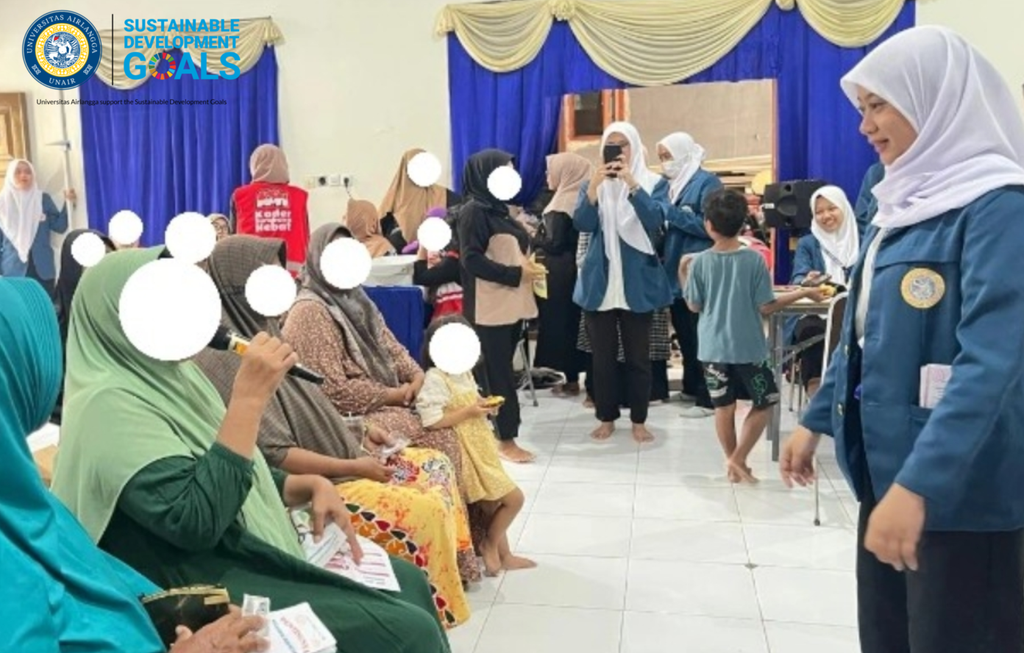
NERS NEWS — On Tuesday, September 8, 2026, Nursing Profession students of Universitas Airlangga, Kalijudan Community Health Center Group, Community and Family Nursing Rotation, Wave 2 (B27), conducted a health education activity entitled “Bunda Cerdas (Bunda Cerdas in Nutrition and Healthy Intake)” at the RW 07 Community Hall, Dukuh Sutorejo Urban Village, Mulyorejo District, Surabaya City. This activity was part of promotive and preventive efforts to improve the nutritional status of pregnant women, breastfeeding mothers, infants, and toddlers in the area. The activity was attended by pregnant women and breastfeeding mothers who showed high enthusiasm for the topic of fulfilling nutritional needs and healthy intake.
The health education activity, which began at 8:00 a.m. WIB, was held alongside the Family Posyandu activity and was therefore also attended by Kesehatan Surabaya Hebat (KSH) cadres, those responsible for toddlers, and local RW representatives. This collaboration strengthened the synergy between students, healthcare professionals, cadres, and the community in supporting the implementation of community-based health activities.
The background of this activity was based on the results of a door-to-door survey conducted by students in RW 07, Dukuh Sutorejo Urban Village. Of the 4 pregnant women assessed, 1 pregnant woman (25%) was found not to routinely consume Iron Supplement Tablets (TTD), and 1 pregnant woman (25%) experienced preeclampsia. Meanwhile, among the 36 infants and toddlers recorded, 8 children (22.2%) had a history of malnutrition or had previously been Below the Red Line (BGM), 8 children (22.2%) did not receive exclusive breastfeeding, and 2 children (5.56%) had been given complementary foods before the age of 6 months. These findings became the basis for determining the community nursing diagnosis of Community Health Deficit, while also serving as an important background for conducting this educational activity.
The health education addressed the theme of balanced nutrition for pregnant women and breastfeeding mothers, nutritional needs and sources of nutritious food, the importance of consuming TTD, as well as the implementation of the “Isi Piringku” concept. The materials presented included the definition and benefits of balanced nutrition for pregnant women, breastfeeding mothers, infants, and toddlers, considering that this period is part of the First 1,000 Days of Life, which is highly influential in determining children’s growth and development in the future.
During this session, Nisa, as the presenter, also explained various essential nutrients and their food sources, such as carbohydrates, animal and plant-based protein, vitamins, minerals, fiber, iron, folic acid, and calcium. Participants were provided with an understanding of the importance of consuming at least 90 Iron Supplement Tablets during pregnancy, the proper way to consume TTD, namely taking them after dinner together with a source of vitamin C or animal protein, as well as the recommendation not to consume them together with tea, coffee, or milk.
In addition, participants were introduced to the “Isi Piringku” concept as a simple guide for arranging daily meals consisting of staple foods, side dishes, vegetables, and fruits in balanced portions. The presenter also explained healthy eating habits that need to be implemented, such as consuming a variety of foods and limiting sugar, salt, and fat, while also reminding participants of habits that should be avoided, such as frequently consuming fried foods and sugary drinks.
The series of activities was also complemented by pre-tests and post-tests to measure the increase in participants’ knowledge, as well as anthropometric screening in the form of weight and height/length measurements for pregnant women, infants, and toddlers who attended. The educational media used included a presentation (PPT) and leaflets containing information on balanced nutrition that participants could take home as reading material and a reminder for use at home.
Overall, the health education activity ran smoothly, with high enthusiasm from the participants. Participants actively listened to the materials presented in easy-to-understand language and participated in discussion and question-and-answer sessions with the presenter. Participants also demonstrated a good understanding of the materials presented, ranging from types of essential nutrients, the benefits and proper way to consume TTD, to the implementation of the “Isi Piringku” principle in daily meals.
Through the “Bunda Cerdas” activity, pregnant women and breastfeeding mothers in RW 07, Dukuh Sutorejo Urban Village, are expected to increasingly understand and implement the principles of balanced nutrition, routinely consume TTD, and apply healthy eating patterns in their daily lives to support maternal health as well as optimal growth and development of infants and toddlers. Nursing Profession students of Universitas Airlangga are committed to continuing to play an active role in providing sustainable health education as a form of tangible contribution to improving maternal and child health in the community.
Writer: Fitriana/Pokja KIA/Community and Family RW 07, Kalijudan Urban Village





