
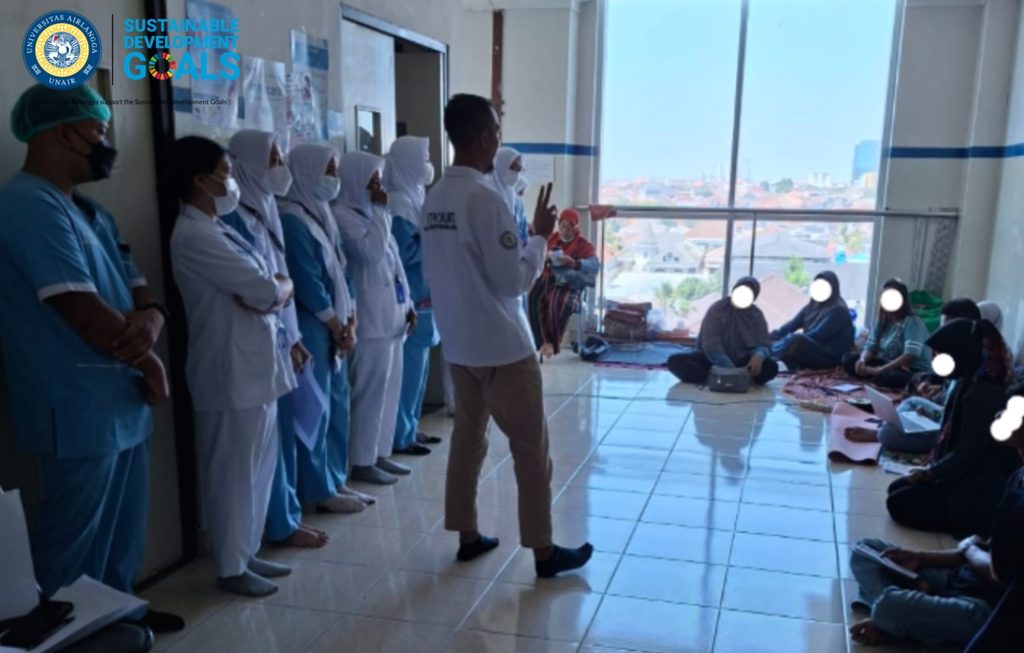
NERS NEWS — Nursing Profession students of the Faculty of Nursing, Universitas Airlangga, conducted a Hospital Health Education (PKRS) activity on Home Range of Motion (ROM) Exercise Care for Post-Stroke Patients for patients’ families at the Stroke Unit of Universitas Airlangga Hospital. This activity aimed to increase families’ understanding and skills in helping post-stroke patients perform ROM exercises properly, safely, and according to the patients’ conditions. This education is expected to support the rehabilitation process, maintain movement function, and improve patients’ independence after being discharged from the hospital.
The education was conducted through direct delivery of the material using leaflets and posters, accompanied by demonstrations of ROM exercises. The materials presented included the definition of stroke, the definition of Range of Motion (ROM), types of ROM consisting of active ROM, passive ROM, and active-assistive ROM, as well as the goals and benefits of ROM exercises for post-stroke patients. Participants were also given an explanation of the principles of performing ROM exercises and how to perform exercises on the upper and lower extremities slowly, safely, and according to the patient’s ability and condition.
The exercise demonstration included movements of the shoulder, elbow, wrist, fingers, thigh, knee, hip, ankle, and toes. Families were given an understanding that ROM exercises can be performed actively by the patient, passively with assistance from family members or healthcare professionals, or actively-assistively with partial assistance from another person. These exercises aim to maintain joint range of motion, maintain flexibility, help reduce stiffness, and support the function and movement ability of the patient’s extremities after a stroke.

This activity targeted families of patients at the Stroke Unit of Universitas Airlangga Hospital. Participants were given the opportunity to discuss and ask questions related to caring for post-stroke patients at home. During the activity, participants followed the presentation and demonstration well and actively participated in the question-and-answer session. Questions raised included the use of pillows as support during ROM exercises and the actions that should be taken if the patient experiences another stroke attack. Families were also educated to immediately recognize signs of stroke, such as weakness or numbness on one side of the body, facial drooping, and speech difficulties, and to immediately seek medical assistance if these symptoms appear.
This PKRS activity aimed to improve families’ health literacy and skills in supporting the care and rehabilitation of post-stroke patients at home. Through education on ROM exercises, families are expected to be able to help patients perform the exercises properly, safely, gradually, and according to the patients’ abilities. Thus, this education can support efforts to maintain movement function and improve patients’ independence during the post-stroke recovery process.
Writer: Dina & Ganjar (Group 3)





