
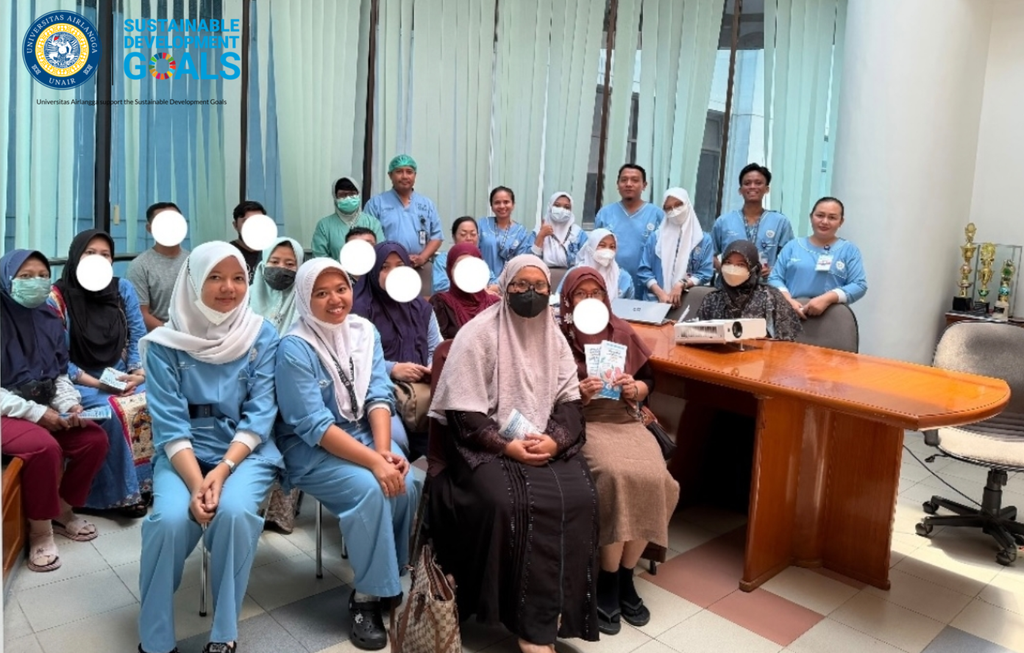
NERS NEWS — Nursing Profession students of the Faculty of Nursing, Universitas Airlangga, conducted a Hospital Health Promotion (PKRS) activity on the introduction to Chronic Kidney Disease (CKD) and signs of deterioration that need to be monitored. This activity was conducted in the Meeting Room (Oval Room) of the ICU GBPT, RSUD Dr. Soetomo Surabaya, on Thursday, September 17, 2026, from 10:00 a.m. WIB until completion. The activity was aimed at families of ICU GBPT patients as an effort to increase their understanding of chronic kidney disease and their ability to recognize changes in the patient’s condition that require further attention and evaluation by healthcare professionals.
The activity was conducted using interactive lectures, discussions, and question-and-answer sessions supported by PowerPoint (PPT) and leaflets as educational media. The materials presented included the definition of Chronic Kidney Disease (CKD), kidney function, CKD risk factors, simple stages of CKD, signs and symptoms of CKD, possible complications, signs of deterioration that need to be monitored, as well as conditions that require medical evaluation or assistance. Throughout the activity, participants followed the education well, paid attention to the materials presented, and participated in the discussion and question-and-answer sessions.
This activity was conducted by Nursing Profession Education Program students of Batch 48, Group 4, Wave 2, Emergency, Critical, and Disaster Nursing Rotation, namely Andi Setio Wahyudi, Rendra Wahyu Ismawan, Ni Putu Eka Maharani, Rokhma Mista Febrianah, and Awig Purbaningrum, under the guidance of academic and clinical supervisors. The entire series of activities proceeded according to the planned schedule, beginning with the opening, delivery of materials, discussion and question-and-answer session, evaluation, and closing. Activity documentation, attendance lists, observation sheets, and note-taking sheets were also prepared and documented as part of the activity reporting.
This education was conducted based on the importance of family understanding of CKD, which can develop gradually and often does not cause clear symptoms in its early stages. Knowledge of the signs and symptoms as well as signs of CKD deterioration is necessary so that families can recognize changes in the patient’s condition, such as newly occurring or worsening shortness of breath, increasing swelling, decreased urine output, persistent vomiting, changes in consciousness, or a worsening general condition. Through this education, families are expected to be able to immediately report changes in the patient’s condition to healthcare professionals so that further assessment and management can be carried out.
This health education activity also supports the achievement of the Sustainable Development Goals (SDGs), particularly SDG 3: Good Health and Well-Being, SDG 4: Quality Education, and SDG 17: Partnerships for the Goals. Overall, this activity is expected to benefit patients’ families by increasing their knowledge of CKD and their awareness of signs of deterioration in the patient’s condition. Health education activities such as this are expected to continue to be carried out sustainably as a form of contribution by educational institutions in supporting increased knowledge and improving public health.
Writer: Awig Purbaningrum





