
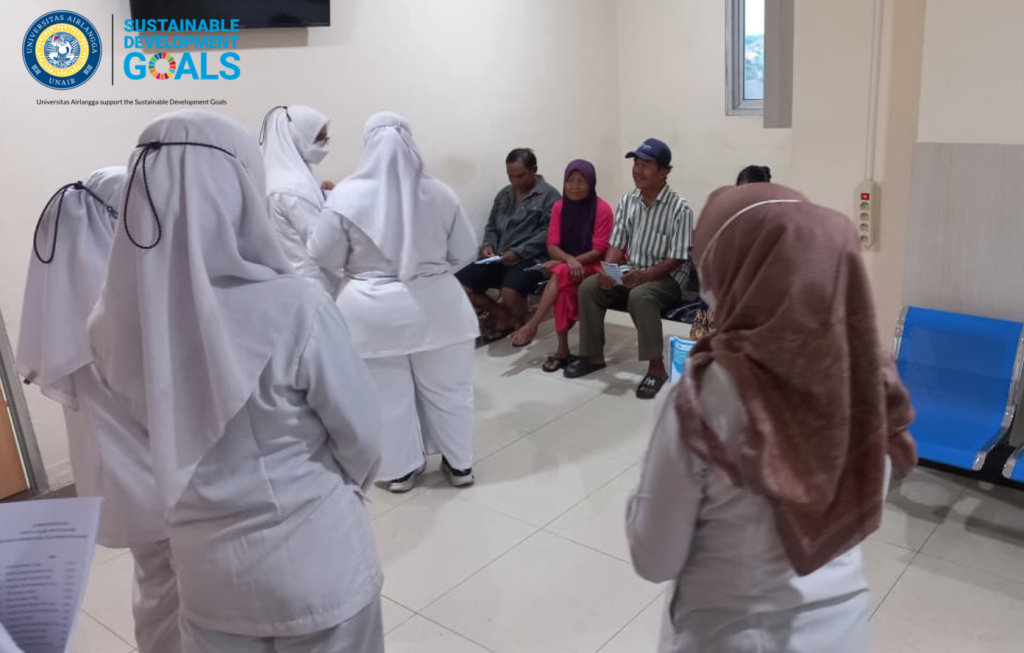
NERS NEWS – Surabaya, April 10, 2026 – Students of the Professional Nursing Program, Faculty of Nursing, Universitas Airlangga, conducted a Hospital Health Education Program (PKRS) themed surgical wound infection prevention for patients’ families at OK Graha Trimed on Friday (April 10) at 2:00 p.m. WIB. The activity aimed to improve families’ knowledge and preparedness in preventing postoperative complications through education and direct demonstrations.
This PKRS activity included the delivery of material regarding the definition of surgical wounds, signs of infection, risk factors, and preventive measures that can be carried out at home. The methods used included lectures, demonstrations, and interactive discussions. Demonstrations focused on proper handwashing practices, how to observe wounds, and principles of changing dressings according to healthcare professionals’ recommendations. To make the material easier to understand, it was presented using the acronyms “BENGKAK” for signs of infection, “SEHAT” for risk factors, and “AMAN” as principles of prevention.
The activity was carried out by Professional Nursing students from the Medical-Surgical Nursing Rotation, Faculty of Nursing, Universitas Airlangga, targeting family members accompanying patients at OK Graha Trimed, Surabaya. This education program was based on the important role of families in supporting postoperative patient care, especially in maintaining hygiene, assisting with care, and detecting early signs of infection. Through this activity, families were expected to play an active role in maintaining patient safety and preventing further complications.
This activity also supports the achievement of the Sustainable Development Goals (SDGs), particularly SDG 3: Good Health and Well-Being and SDG 4: Quality Education, through improving health literacy and empowering families in infection prevention. One student representative stated that this education was expected to increase families’ independence in caring for patients. “We hope that patients’ families can be more alert in recognizing signs of infection so that complications can be prevented earlier,” the representative said.
Through this activity, Professional Nursing students not only strengthened their role as educators but also made a tangible contribution to improving patient safety. In the future, similar activities are expected to continue as a form of community service while supporting improvements in healthcare quality and the achievement of the SDGs.
Writer: Anindiya Putri
Editor: Nandyta Putri Rahmadhani (Airlangga Nursing Journalist)





