
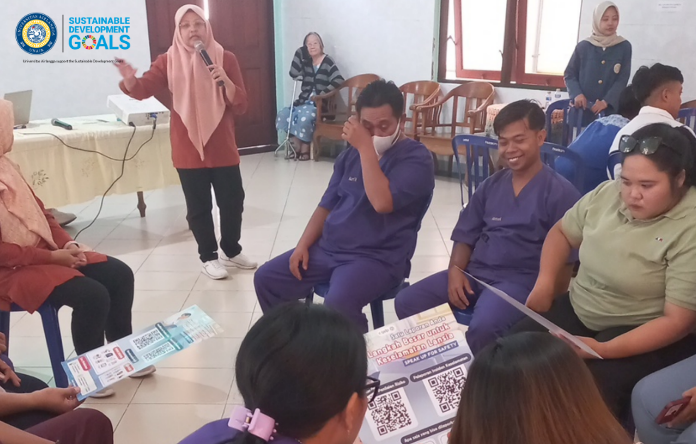
NERS NEWS — Continuous efforts to elevate service quality and geriatric safety were demonstrated through a community service initiative for nurses, elderly caregivers, and nursing home administrators. Organized by a team of lecturers from the Faculty of Nursing, Universitas Airlangga, the program took place at Panti Pangesti in Malang on Saturday, June 6, 2026. The event featured an interactive training workshop that combined theoretical sessions, field assessments, and an elderly simulation experience to deeply reinforce the participants’ understanding of patient safety culture within institutional eldercare environments.
The training commenced with a core lecture on Risk Management, Incident Reporting, and Continuous Quality Improvement, emphasizing the critical importance of identifying potential hazards before an actual adverse event occurs. Participants were guided on how to cultivate a non-punitive safety culture through transparent incident reporting and how to utilize these reports as data-driven foundations for clinical service improvement. This was followed by an in-depth session on Fall Prevention and Management for the Elderly, addressing one of the most prevalent safety challenges encountered in geriatric populations.
The workshop, which commenced at 12:00 PM WIB, was facilitated by Dr. Ika Nur Pratiwi, S.Kep., Ns., M.Kep. and Dr. Retno Indarwati, S.Kp., M.Kep. Following the lectures, participants conducted a hands-on environmental walk-through across the nursing home facility to identify structural hazards that could trigger accidents or injuries among the residents. The identified risks were then systematically documented and reported using a customized Google Form-based platform, enabling caregivers to experience an authentic and structured digital incident reporting workflow.
A unique feature of this training was the empirical simulation session, where participants donned an aging simulator. This specialized apparatus allowed caregivers to personally experience the physiological limitations commonly faced by older adults. Through this simulation, they directly experienced how deficits in visual acuity, altered balance, and restricted mobility significantly impair daily living activities. This immersive experience was designed to heighten empathy among nurses, caregivers, and managers alike, driving them to proactively design a more accessible and protective environment for the elderly.
As an integral part of the practical drills, participants also demonstrated the proper utilization of mobility assistive devices and simulated immediate response protocols during an accidental fall. This simulation block provided a vital hands-on arena for attendees to translate theoretical knowledge into rapid, safe, and clinically sound interventions when managing emergency fall scenarios in the facility.
Furthermore, this community service initiative directly aligns with the global framework of the Sustainable Development Goals (SDGs), specifically:
- SDG 3: Good Health and Well-Being: Maximizing geriatric safety and lowering injury rates in long-term care facilities.
- SDG 4: Quality Education: Providing practice-based, continuous professional education on risk management, incident documentation, and evidence-based fall protocols for healthcare workers.
By seamlessly bridging clinical education, field diagnostic practice, and high-fidelity sensory simulation, this community outreach program is expected to robustly solidify a sustainable safety culture within elderly care institutions. The competencies gained by the staff serve as an invaluable asset in establishing care delivery that is significantly safer, highly responsive, and fundamentally oriented toward enhancing the overall quality of life for senior residents.
Author: Yumna Raihanatu
Editor: Farah Dina Azizatul Aulia (Airlangga Nursing Journalist)





