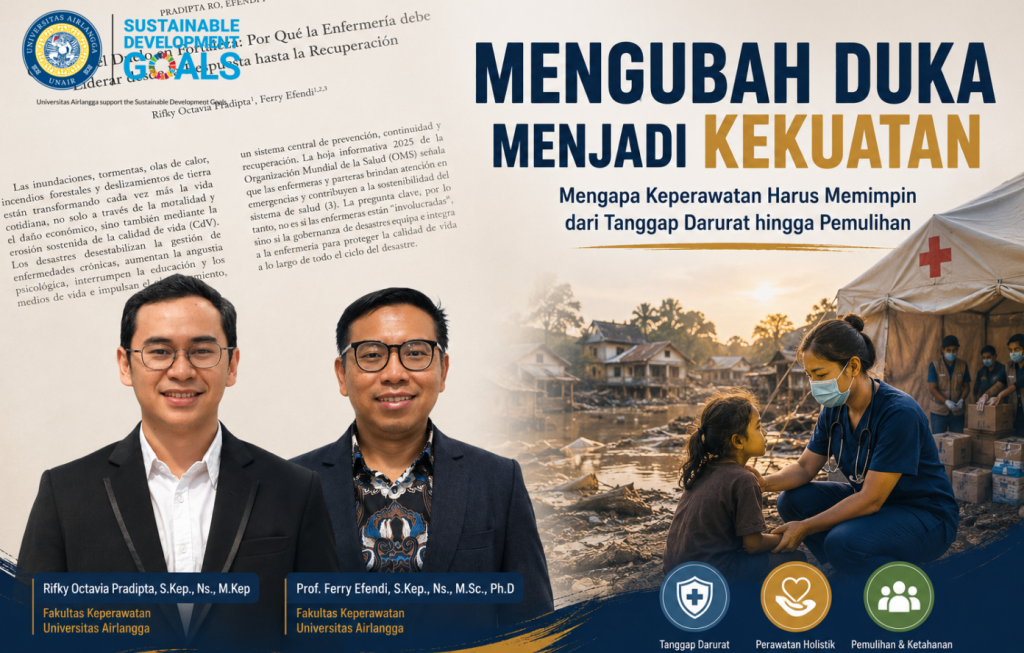
NERS NEWS — Natural disasters such as floods, storms, and heatwaves not only leave material losses and death, but also affect the level of Quality of Life (QoL) of individuals. In this regard, nurses cannot be viewed as a supporting profession, but rather become central to disaster prevention, continuity, and recovery. Post-disaster recovery is not only limited to rebuilding public infrastructure, but must also ensure quality of life, safety, mental health, and the sustainability of life for disaster survivors.
Two researchers from the Faculty of Nursing, Universitas Airlangga, Rifky Octavia Pradipta, S.Kep., Ns., M.Kep., and Prof. Ferry Efendi, S.Kep., Ns., M.Sc., Ph.D., in their latest research article discussed the significant role of nurses during disaster periods. This article discusses the extent to which disaster governance empowers and integrates the nursing profession to maintain quality of life throughout the disaster cycle, starting from preparedness, emergency response, to recovery. Throughout the entire disaster cycle, nurses have a major role in maintaining service continuity such as triage management, ensuring medicine supplies, maternal and child health services, infection prevention and monitoring, as well as health education and promotion at disaster sites.
According to the latest report by the Internal Displacement Monitoring Centre (IDMC) 2025, there are 83.4 million people living in displacement due to disasters. This report highlights how long each individual can survive under post-disaster conditions. In this regard, nurses have a more holistic role in long-term refugee camps, which not only focuses on physical treatment, but also on social, emotional, and preventive aspects in order to maintain the quality of life of refugees. To face all of these challenges, a more prepared and resilient nursing system in dealing with disasters needs to be implemented.
This research article also focuses on the importance of WASH (Water, Sanitation, and Hygiene) shelter standards in disaster management. These standards are not merely complementary assistance during a disaster, but become highly crucial in preventing infections, maintaining maternal and child health, supporting mental health, and ensuring more dignified conditions for disaster survivors.
To establish a disaster nursing system that is prepared and resilient, thorough preparation is required, including pre-disaster competency training based on the standards of the International Council of Nurses (ICN). With pre-disaster training, psychological stress among nurses can be effectively reduced. According to Luo Y et al., pre-disaster preparedness for nurses is considered highly effective in reducing psychological stress, thereby strengthening the rationale for conducting systematic competency-based training. In addition, to establish a good working system, the Sendai Framework is used to involve nurses starting from the dissemination of early warnings, community preparedness, service continuity planning, and the recovery process.
This research article is in line with Sustainable Development Goals (SDGs) No. 3: Good Health and Well-Being, SDGs No. 11: Sustainable Cities and Communities, and SDGs No. 13: Climate Action. Through strengthening disaster nursing systems, healthcare workforce preparedness, protection of vulnerable groups, as well as the sustainability of healthcare services and quality of life for affected communities, the nursing profession plays an important role in creating a more resilient health and social system amidst the increasing risks of climate-related disasters.
Full article link: https://saber.ucv.ve/ojs/index.php/rev_gmc/article/view/31989
References:
- Internal Displacement Monitoring Centre (IDMC). 2025 Global Report on Internal Displacement (GRID). Geneva: IDMC; 2025. Available from: https://www.internal-displacement.org/
- Luo Y, Yan H, Tang Y, Wang S, Yang Z, Zhang T, et al. Levels of nurse disaster preparedness: A systematic review and meta-analysis. Nurse Education in Practice. 2025;85:104372.
- Pradipta, R. O., & Efendi, F. (2026). Converting Grief into Strength: Why Nursing Must Lead from Response to Recovery. Gaceta Medica de Caracas, 134(Suppl 1), S1–S5.
Writer: Yusuf Rayhan Sameer