
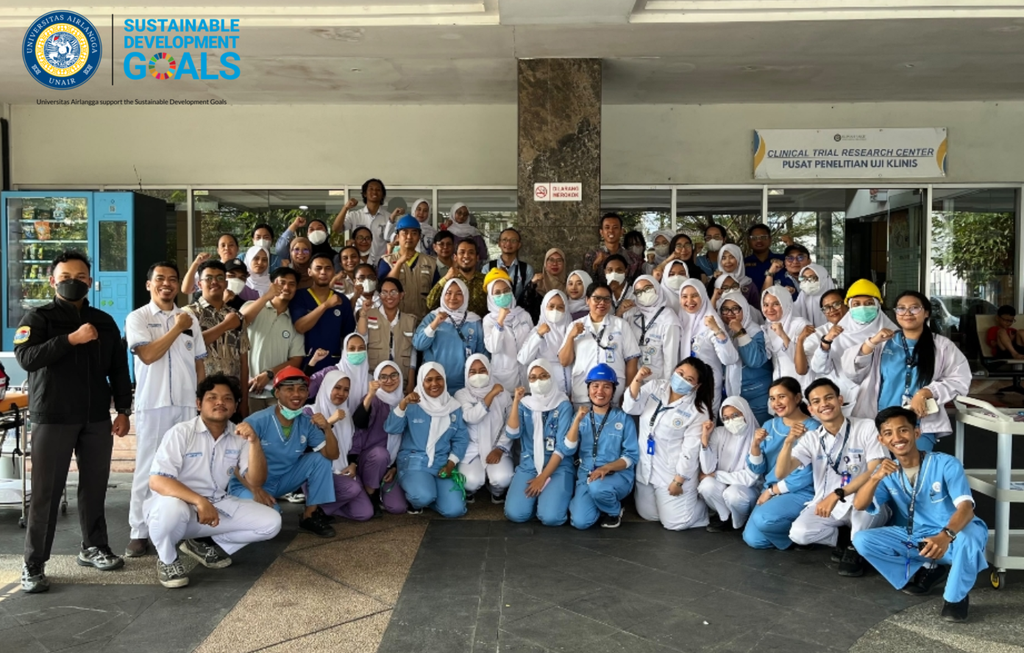
NERS NEWS — Nursing Profession Education Program students of the Faculty of Nursing, Universitas Airlangga, conducted a Code Green Simulation at Grha Trimed, Universitas Airlangga Hospital. This activity was part of the Emergency, Critical, and Disaster Nursing Rotation, which aimed to improve students’ preparedness in facing emergency and disaster conditions in the hospital environment.
The simulation featured a scenario involving an earthquake disaster followed by a local fire caused by an electrical disturbance. Participants were trained to carry out self-protection, assess environmental conditions, report incidents, and activate Code Green. Subsequently, coordination among personnel was carried out to ensure the safety of the area, determine evacuation routes, and protect and evacuate patients according to their respective conditions.
The activity was held on Thursday, September 10, 2026, at 2:00 p.m. WIB on the 2nd floor of Grha Trimed, Universitas Airlangga Hospital. The activity was conducted through collaboration between Nursing Profession students of the Faculty of Nursing, Unair, Occupational Health and Safety of Universitas Airlangga Hospital (K3RS), and Nursing Specialist students of the Faculty of Nursing, Unair. The activity was carried out under the guidance of Ms. Erna Dwi Wahyuni, S.Kep., Ns., M.Kep., as the academic supervisor, and Mr. Yogo Apriawan, S.Kep., Ns., M.Kep., as the clinical supervisor.
During the implementation, participants took on various roles within the hospital disaster management system, ranging from Incident Commander, medical, evacuation, security, K3, IPSRS, logistics, to communication and public relations teams. Each team had integrated duties and responsibilities to ensure that the response and evacuation processes were carried out in a coordinated manner.
One of the important stages in the simulation was victim triage based on the level of emergency. Patients were then evacuated through safe routes to the Casualty Collection Area (CCA) for further treatment. In the scenario, there were 2 red-category victims, 3 yellow-category victims, and 10 green-category victims. The evacuation process also considered the use of assistive equipment such as wheelchairs, stretchers, and oxygen according to patients’ needs.
Through this activity, students gained experience in applying the principles of self-safety, patient protection, effective communication, cross-unit coordination, evacuation, and triage in disaster situations. Collaboration with K3RS and Nursing Specialist students also provided participants with experience in understanding the importance of multidisciplinary teamwork in dealing with emergency and disaster conditions in hospitals.
The activity concluded with an evaluation and debriefing to review the simulation process, including activation speed, communication effectiveness, resource readiness, evacuation implementation, patient safety, and coordination among units. The evaluation results are expected to serve as a basis for improvement in enhancing preparedness and the implementation of the Hospital Disaster Plan (HDP) within the hospital environment.
Writer: Muzzaiyanah and Nabillah Kanza Zuana





