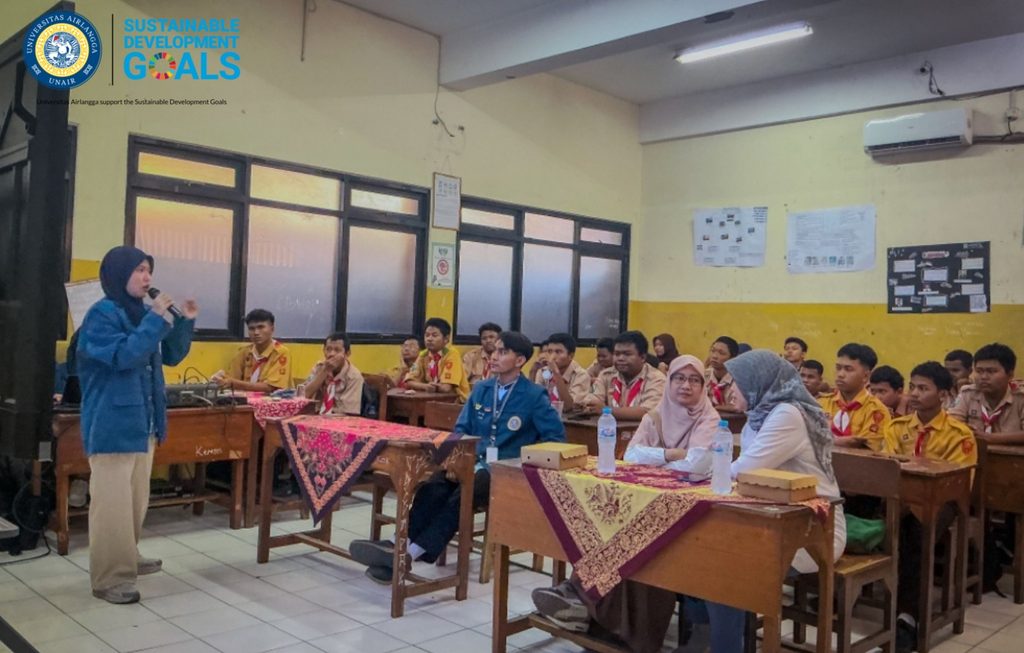
NERS NEWS — Surabaya — Undergraduate nursing students from the Faculty of Nursing, Universitas Airlangga, through Integrated Project-Based Learning (PJBL) Group 3 Class A1, initiated a health education program titled SAFE (Stay Aware, Fight HIV & Empower Ourselves). This event was held on Friday, October 30, 2026, at SMK PGRI 4 Surabaya. The program focused on increasing youth knowledge and awareness regarding risky sexual behaviors associated with HIV/AIDS incidence rates among adolescents, reproductive health disorders, and explaining facts to eliminate stigma and discrimination against people living with HIV (PLHIV).
The SAFE Program was executed as a health education effort by actively involving students in every stage of the event. The agenda began with a pre-test to assess students’ baseline knowledge about HIV/AIDS prior to receiving educational material. The pre-test questions encompassed several topics, including the definition of HIV/AIDS, modes of transmission, risk factors, prevention methods, as well as stigma and discrimination toward people living with HIV (PLHIV). The pre-test results provided an initial overview for the committee regarding students’ understanding before the activity commenced.
Next, a short video depicting risky sexual behaviors and their subsequent impact on reproductive health and future well-being was presented as a starter before the core material was delivered via a PowerPoint (PPT) presentation. Following the material presentation, students were given the opportunity to ask questions and seek clarification on topics they did not yet fully understand. In the subsequent session, the lecturer provided reinforcement and material clarification to deepen students’ understanding and correct any lingering misconceptions. To conclude, students completed a post-test to evaluate their understanding after attending the educational session. The post-test results were then compared with the pre-test results to measure changes and knowledge enhancement following the SAFE Program.
This educational activity involved Group 3 Class A1 Class of 2024 undergraduate nursing students from the Faculty of Nursing, Universitas Airlangga, chaired by Adam Dzulfikri Wafiq. Throughout its execution, the activity was guided by Nuzul Quraniati, S.Kep.Ns., M.Ng., Ph.D. as the supervising lecturer, alongside Dr. Aria Aulia Nastiti, S.Kep., Ns., M.Kep., Dr. Purwaningsih, S.Kp., M.Kes., and Dr. Retno Indarwati, S.Kp., M.Kep. as advisory lecturers. In conducting this program, the students collaborated with SMK PGRI 4 Surabaya, located on Jalan Kalijudan IX No. 26–28, Mulyorejo District, Surabaya, as a partner and venue for the HIV/AIDS education.
The SAFE Program serves as a form of care toward HIV/AIDS issues, which remain a major concern requiring prevention efforts through health education. Based on the 2025 Surabaya City Health Profile cited in the activity proposal, there were 1,119 HIV cases in Surabaya, comprising 894 cases among males and 225 cases among females. This data underscores the importance of fostering an understanding of HIV/AIDS starting from adolescence. Through this activity, students are expected to gain a better understanding of HIV/AIDS, how it is transmitted, factors that increase risk, and preventive steps. Furthermore, this education aims to boost student awareness of the importance of HIV testing and antiretroviral (ARV) treatment. Equally important, the SAFE Program is expected to cultivate empathy and mutual respect, ensuring students do not easily stigmatize or discriminate against people living with HIV (PLHIV).
Through the SAFE Program, Faculty of Nursing Universitas Airlangga students actively contribute to supporting the achievement of the Sustainable Development Goals (SDGs). This initiative aligns with SDG 3: Good Health and Well-Being, as it strives to enhance adolescent health knowledge and awareness, particularly in HIV/AIDS prevention. Additionally, the program supports SDG 4: Quality Education by delivering informative and interactive health education that is easily understood by students. Furthermore, the collaboration between the Faculty of Nursing Universitas Airlangga and SMK PGRI 4 Surabaya reflects the implementation of SDG 17: Partnerships for the Goals through inter-institutional educational collaboration to jointly raise public health awareness and literacy.
Moving forward, the SAFE Program is expected to serve as a concrete step by nursing students toward enhancing health awareness, particularly within school environments. Through this education, students are expected not only to gain new insights into HIV/AIDS, but also to apply them in daily life—making wiser decisions, maintaining reproductive health, and recognizing the importance of HIV/AIDS prevention. Moreover, this activity is hoped to foster mutual respect and reduce negative perceptions of people living with HIV (PLHIV). With continuous health education efforts, nursing students are expected to maintain an active role in disseminating health information and supporting HIV/AIDS prevention initiatives, both in schools and the wider community.
Writer: Secretary of PJBL Group 3 Class A1/2024