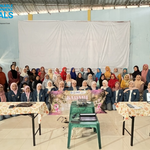
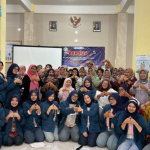
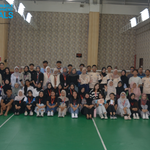
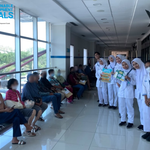
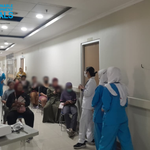
NERS NEWS— A group of students conducted a worker health education activity entitled “Healthy at Work, Productive in Action: Occupational Health Efforts (UKK) to Prevent Occupational Diseases through the Implementation of Occupational Safety and Health (K3) and Ergonomics” on Friday, August 14, 2026, at 7:00 p.m. Western Indonesia Time (WIB) at the RW 03 Community Hall, Dukuh Sutorejo Village, Surabaya. The activity targeted informal-sector workers in the RW 03 area, including laundry workers, food vendors, grocery store workers, and other small and medium-sized business owners. The activity aimed to increase workers’ knowledge and awareness of the importance of Occupational Health Efforts (UKK) in preventing occupational diseases through the implementation of Occupational Safety and Health (K3) and ergonomics in daily work activities.
The health education activity was delivered through interactive lectures, educational videos, stretching demonstrations, and question-and-answer sessions using PowerPoint presentations and leaflets. The materials covered the definition and objectives of UKK, the definition and objectives of K3, workplace hazards and risk factors, occupational diseases and their prevention, the use of Personal Protective Equipment (PPE), the application of ergonomics and proper working postures, as well as simple stretching exercises before and during work. The materials were presented using examples tailored to the participants’ occupations, enabling them to identify potential health risks in their daily work activities.
Throughout the activity, participants demonstrated enthusiasm by paying attention to the presentation, watching the educational video, participating in the stretching demonstration, and actively engaging in discussions. Participants also asked questions based on their personal experiences and working conditions. Several questions concerned how to detect occupational diseases at an early stage, how to distinguish ordinary back pain from work-related back pain, and what types of health complaints should be examined at a healthcare facility.
Participants were provided with examples of K3 and ergonomic practices appropriate to their respective occupations. These included the risk of exposure to detergents and cleaning products among laundry workers; exposure to heat, sharp objects, and prolonged standing among food vendors; as well as the risks associated with lifting loads and adopting non-ergonomic working positions among grocery store workers and other small and medium-sized business workers. Participants also took part in a stretching demonstration involving the neck, shoulders, hands, back, and legs to help reduce tension and fatigue caused by work.
As part of the evaluation, participants completed pre-tests and post-tests to assess changes in their knowledge following the health education session. They were also given opportunities to ask questions and discuss strategies for preventing occupational diseases according to their respective working conditions. The activity concluded with the reinforcing message “Healthy at Work, Productive in Action”, encouraging workers to prioritize their health and safety while carrying out their jobs. Leaflets were distributed to participants as educational materials that could be reviewed again to reinforce information on preventing occupational diseases through the implementation of K3 and ergonomics.
Through this activity, workers are expected to be able to identify workplace hazards and risk factors, understand efforts to prevent occupational diseases, use PPE according to their needs, apply ergonomic working positions, and perform regular stretching and rest periods. The activity also supports the achievement of the Sustainable Development Goals (SDGs), particularly SDG 3: Good Health and Well-Being, through improving health literacy and preventing diseases, as well as SDG 8: Decent Work and Economic Growth, by increasing workers’ awareness of the importance of safe, healthy, and productive working conditions.
Writer: Rika Eka Permata Ayunda