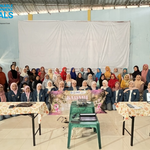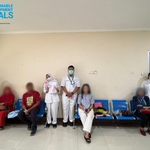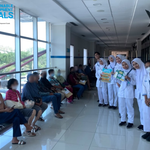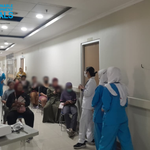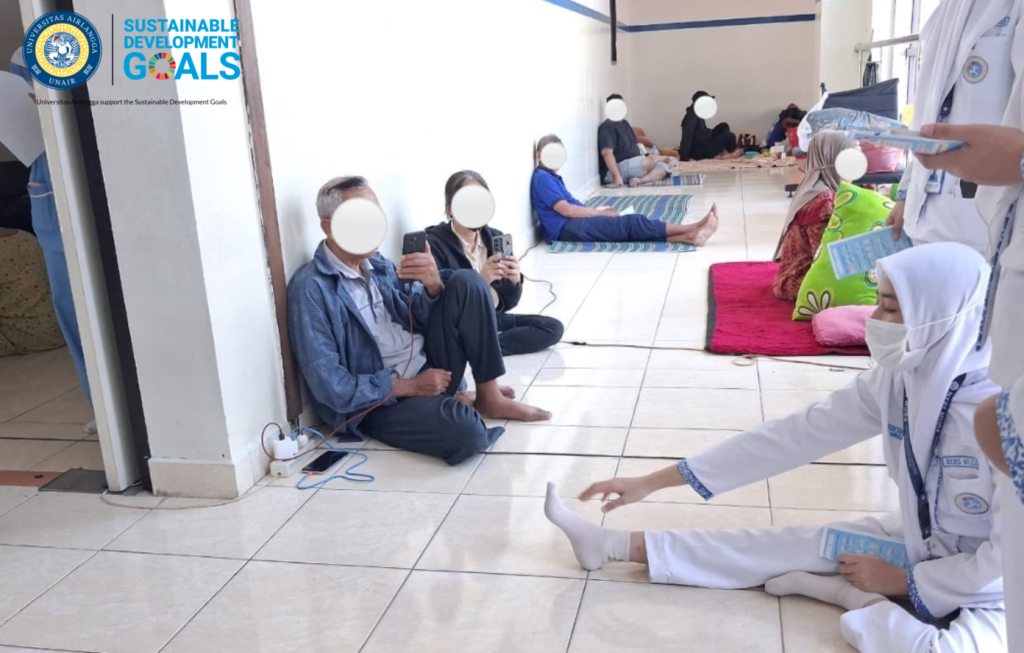
NERS NEWS — Nursing Profession students from the Faculty of Nursing, Universitas Airlangga conducted a Hospital Health Promotion (PKRS) activity with the theme “Physiotherapy for Post-Stroke Patients with Range of Motion (ROM) Exercises” on Thursday, July 30, 2026, in the ICU waiting room of Universitas Airlangga Hospital. The activity was conducted through lectures, discussions, and interactive question-and-answer sessions using leaflets and posters, with the aim of increasing patients’ families’ knowledge about the importance of physiotherapy and Range of Motion (ROM) exercises as part of the rehabilitation process for post-stroke patients.
This health education activity provided information about physiotherapy for post-stroke patients, the benefits of physiotherapy in helping restore motor function, the definition of Range of Motion (ROM) exercises, types of ROM, the benefits of ROM exercises, and the principles of performing exercises safely according to the patient’s condition. The speaker explained that ROM exercises are a form of rehabilitation that can help maintain joint range of motion, improve muscle strength, prevent joint stiffness, improve blood circulation, and support the recovery process of post-stroke patients.
In addition to explaining physiotherapy and ROM exercises, the students also provided education about the importance of family involvement in accompanying patients throughout the rehabilitation process. Families play an important role in helping patients perform exercises regularly, assisting with exercises according to healthcare professionals’ recommendations, helping move weakened limbs, and providing support and motivation during the recovery process. Optimal family support is expected to improve the success of rehabilitation and the quality of life of post-stroke patients.
The activity was conducted by Nursing Profession students from the Faculty of Nursing, Universitas Airlangga, Group 2 of the Critical Nursing Clinical Rotation, targeting patients’ families in the ICU waiting room at Universitas Airlangga Hospital. During the activity, participants showed high enthusiasm by paying attention to the material presented and actively participating in the discussion and question-and-answer session. One of the questions raised by a participant concerned exercises that could be performed by stroke patients experiencing weakness in the facial muscles. In response, the speaker explained that exercises could be performed gradually through stimulation and simple facial movements, such as smiling, raising the eyebrows, puffing out the cheeks, and moving the lips according to the patient’s ability and healthcare professionals’ recommendations. Overall, the activity ran smoothly, interactively, and received positive responses from the participants.
The activity was conducted under the guidance of Academic Advisor Harmayetti, S.Kp., M.Kes. and Clinical Advisor Andis Yuswanto, S.Kep., Ns., M.Kep. This PKRS activity aimed to improve patients’ families’ knowledge and skills in supporting the rehabilitation process of post-stroke patients through ROM exercises performed correctly, safely, and consistently. This health education activity also served as a form of contribution by the students to improving the quality of healthcare services by empowering families as an important part of the patient care and rehabilitation process.
Through this PKRS activity, patients’ families are expected to understand the importance of physiotherapy and ROM exercises and to actively participate in accompanying patients throughout the rehabilitation process, both during hospitalization and after the patients return home. With appropriate exercises and continuous family support, the recovery of motor function in post-stroke patients is expected to take place more optimally, thereby improving their quality of life.
Writer: Dhea Triananda