
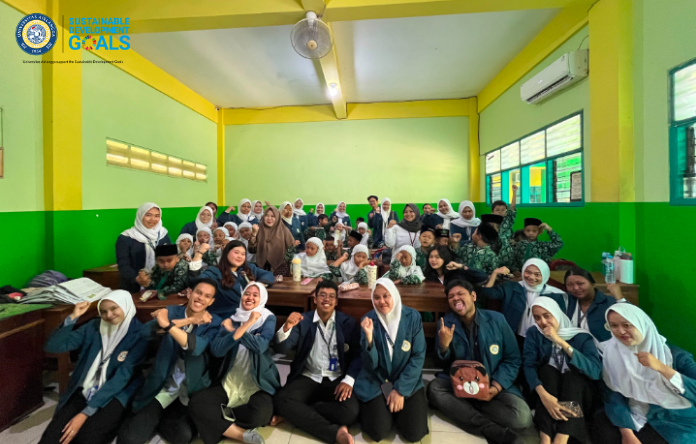
NERS NEWS— Friday, August 14, 2026 – Students of the Nursing Professional Education Program, Faculty of Nursing, Universitas Airlangga, conducted a health education session entitled “Six Magical Moves: The Secret to Clean and Healthy Hands” at Al-Islam Elementary School, Dukuh Sutorejo Village, Surabaya. This activity was part of the Community and Family Nursing Clinical Practice for Wave 1 of the 48th Nursing Professional Program cohort, conducted through Kalijudan Community Health Center (Puskesmas Kalijudan). The target participants were first-grade students of Al-Islam Elementary School.
The health education session was conducted as a promotive and preventive effort to establish clean and healthy living behaviors from an early age, particularly through the practice of Handwashing with Soap (HWS). The materials covered the definition of handwashing with soap, the benefits of washing hands with soap, the negative effects of not washing hands, the six proper handwashing steps, and important times for handwashing.
The activity employed interactive lectures, educational videos, demonstrations, hands-on practice, and question-and-answer sessions. The delivery of the materials was supported by PowerPoint presentations, an educational video demonstrating the six handwashing steps, educational posters, and hand soap used during the practical session. Participants first observed a demonstration of the six handwashing steps and then practiced them together under the guidance of facilitators. The activity was held on Friday, August 14, 2026, at 8:00 a.m. Western Indonesia Time (WIB) at Al-Islam Elementary School, Dukuh Sutorejo Village, Surabaya. A total of 26 first-grade students participated in the activity.
The materials emphasized that washing hands with soap is one of the clean and healthy living behaviors that can help clean the hands while breaking the chain of germ transmission. Participants were also provided with an understanding of the benefits of HWS in preventing various diseases, including diarrhea and respiratory tract infections, as well as the importance of thoroughly cleaning all parts of the hands. The six movements taught included rubbing the palms, backs of the hands, between the fingers, fingertips, thumbs, and fingertips against the palms.
The participants’ enthusiasm was evident through their active involvement throughout the educational and practical sessions. They not only listened to the materials but also followed the demonstrations and practiced the six handwashing steps together. The practical session was an important component of the health education activity because participants gained not only theoretical knowledge but also direct experience in performing proper handwashing with soap.
The activity was conducted under the guidance of Dr. Makhfudli, S.Kep., Ns., M.Ked.Trop.; Prof. Ferry Efendi, S.Kep.Ns., M.Sc., PhD; and Dr. Eka Mishbahatul M.H., S.Kep., Ns., M.Kep., who served as academic supervisors, as well as Waji, S.Kep., Ns., who served as the clinical supervisor. Through this promotive and preventive activity, the students contributed to the achievement of the Sustainable Development Goals (SDGs), particularly SDG 3: Good Health and Well-being, by increasing public knowledge about disease prevention; SDG 4: Quality Education, by providing accessible and easy-to-understand health education; and SDG 17: Partnerships for the Goals, through collaboration between educational institutions and healthcare facilities in improving community health.
Through this promotive and preventive activity, students are expected to contribute to the development of clean and healthy living behaviors among school-aged children. The knowledge gained through health education, demonstrations, and hands-on practice is expected to be applied consistently both at school and at home, allowing handwashing with soap to become an integral part of students’ daily activities.
Writer: Agustin Novianatasari





