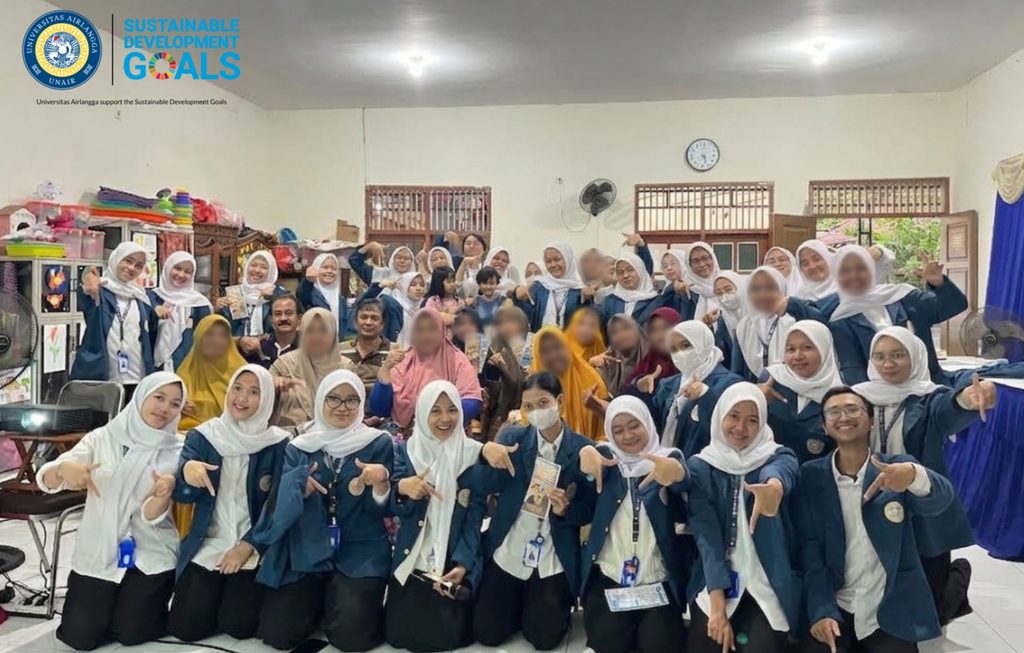
NERS NEWS — Surabaya, September 11, 2026 – Young Nurses of the Nursing Profession Education Program, Faculty of Nursing, Universitas Airlangga, Groups 1, 2, and 3, Family and Community Nursing at Kalijudan Community Health Center, conducted a health education activity with the theme “Safe Work, Clean Hands: Education on Handling Occupational Accidents and the Importance of Handwashing” for business owners in RW 07, Dukuh Sutorejo Urban Village, Surabaya. The activity, which was held at the RW 07 Community Hall, was part of promotive and preventive efforts to increase the community’s knowledge and skills in maintaining health and safety while carrying out work activities. The activity targeted business owners such as MSME operators, vendors, laundry workers, self-employed individuals, and various other types of workers.
Occupational health and safety in the informal sector are important aspects to consider, given that business owners still face risks of various accidents and health problems while working. Based on the background of the activity, occupational accidents can cause injuries while also affecting productivity and business continuity. In addition, the habit of maintaining hand hygiene is also an important part of preventing contamination and disease transmission, particularly for business owners involved in food processing and serving. Therefore, education on handling minor occupational accidents, implementing Occupational Safety and Health (K3), and practicing proper handwashing is an important step in supporting the health of business owners.
The health education activity was conducted through several methods, namely lectures, discussions, demonstrations, and joint practice. The materials provided included the definition and types of minor occupational accidents, basic steps of First Aid for Accidents (P3K), methods of handling and dressing simple wounds, the importance of hand hygiene in preventing contamination and disease, as well as how to wash hands using running water and soap according to the six-step WHO technique. In addition to the material presentation, participants were also given the opportunity to directly practice the movements that had been taught so that the information obtained could be more easily applied in their daily activities.
The activity began with participant registration, health checks, an opening session, and a pre-test. Participants then attended the material presentation, followed by discussions, question-and-answer sessions, and joint practice. Based on the process evaluation, participants showed fairly good enthusiasm throughout the activity. This was evident from their attention during the material presentation, involvement in the practice, and active participation in sharing questions and experiences related to conditions during work. Participants also had the opportunity to receive explanations regarding proper working positions and simple stretching exercises that could be performed between business activities to help maintain health and productivity.
A total of 13 participants completed the pre-test and post-test as part of the activity evaluation. The evaluation results showed that the participants’ average pre-test score was 62.3%, while the average post-test score increased to 92.3%. Thus, there was an increase in the average score of 39.3 points after participants received the education. These results indicate an increase in participants’ understanding of the material provided during the activity.
This activity also faced several challenges, particularly limited time and the number of participants who were able to attend the entire series of activities directly. Some visitors had business activities that needed to be carried out, so not all target participants could attend the education until completion. As an effort to ensure that health information could still reach a wider target audience, the team distributed leaflets containing information on efforts to maintain the health and productivity of business owners, as well as simple stretching exercises that could be performed independently between work activities.
Through this health education activity, Young Nurses of the Nursing Profession Education Program, Faculty of Nursing, Universitas Airlangga, hoped that business owners could increase their awareness of the importance of occupational safety and health and be able to implement simple steps to maintain their health while working. This activity is expected to encourage the formation of safer work behaviors, improve skills in dealing with minor occupational accidents, and promote proper hand hygiene practices. These efforts also support the achievement of the Sustainable Development Goals (SDGs), particularly SDG 3: Good Health and Well-Being and SDG 8: Decent Work and Economic Growth.
Writer: Nur Asa Malinda